Some dishes you eat; cha ca you experience. A sizzling pan arrives at your table on a charcoal burner, the waiter tosses turmeric-yellow catfish with mounds of dill and spring onion, and you build each bite yourself with vermicelli, peanuts, and shrimp paste. The Doan family has served exactly this one dish at 14 Cha Ca Street for over a century. We at the Hanoi Cooking Class Team send every food-loving visitor here at least once. This guide explains what makes the Hanoi version unique, what it costs in 2026, where to eat it, and which cooking classes teach you to make it.
In this guide:
- What makes the Hanoi version different
- How much does it cost in Hanoi
- Where to eat it in Hanoi
- Learn to cook it in Hanoi
- Frequently asked questions
Direct answer: Chả cá is Hanoi’s most theatrical dish: turmeric-marinated catfish sizzled tableside on a charcoal burner with dill and spring onion, then tossed with rice vermicelli, peanuts, and pungent shrimp paste. The original restaurant at 14 Cha Ca Street has served this one dish for over a century, and dill is the Hanoi version’s defining herb.
What makes the Hanoi version different
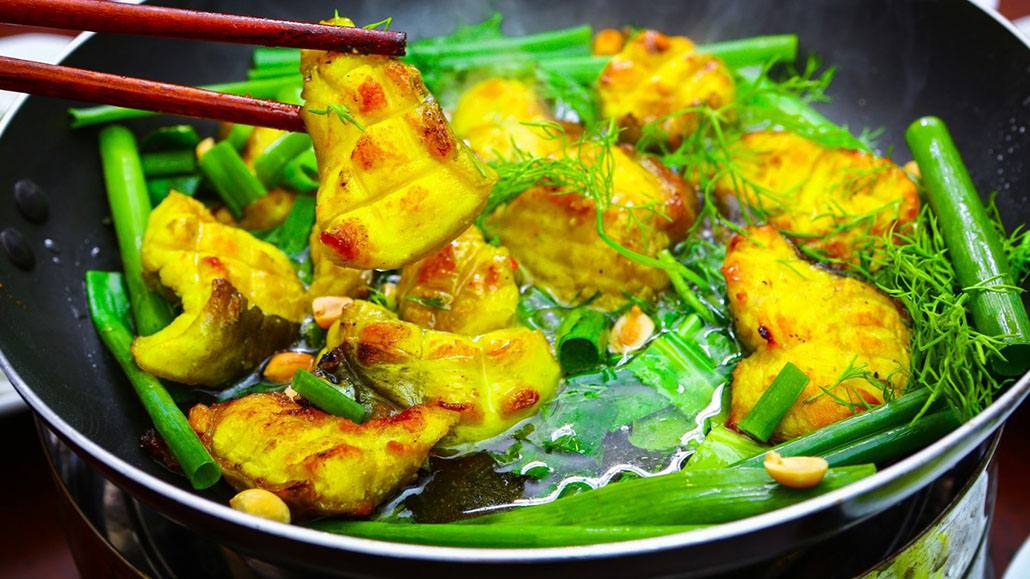
Direct answer: What sets Hanoi’s cha ca apart is the tableside ritual and the dill. Turmeric-marinated catfish is cooked in front of you on a sizzling pan with a tangle of dill and spring onion — a combination rare elsewhere in Vietnamese cooking. You assemble every bite yourself: fish, vermicelli, peanuts, herbs, and pungent shrimp paste.
The dish starts long before it reaches your table. Firm white catfish (hemibagrus) is marinated in turmeric — which gives it that unmistakable golden color — along with the house seasoning. When you order, the fish hits a screaming-hot pan set over a small charcoal burner right on your table, and the server tosses it with huge handfuls of fresh dill and spring onion until everything is fragrant and lightly crisped at the edges.
Then it’s your turn. Take rice vermicelli into your bowl, add the sizzling fish and wilted dill, scatter roasted peanuts and fresh herbs, and finish with shrimp paste — the pungent, purple-grey condiment that is the dish’s signature kick. Mix it all together and eat while it’s still crackling. Dill is the tell: it’s a northern herb rarely used this way anywhere else in Vietnam, and it defines the dish’s flavor.
This is not a quick street-food stop. Chả cá is a sit-down, linger-over-it meal — one pan per table, eaten slowly, usually with cold beer. The entire restaurant exists around this single ritual, which is exactly why it has survived for more than a hundred years.
How much does it cost in Hanoi
Direct answer: Expect about 120,000–150,000 VND per portion at Cha Ca La Vong, the original restaurant at 14 Cha Ca Street, and around 200,000 VND per person at Cha Ca Thang Long. Chả cá is a sit-down restaurant dish, not street food — it costs several times more than a bowl of phở, and it is worth every dong.
| Restaurant | Price | Approx. USD |
|---|---|---|
| Cha Ca La Vong (14 Cha Ca Street, the original) | 120,000–150,000 VND per portion | |
| Cha Ca Thang Long (cheaper alternative) | ~200,000 VND per person |
A portion is generous — the fish, noodles, herbs, peanuts, and condiments all come with it, so the per-person figure at Thang Long (about 700,000 VND for three diners) covers the full spread. For a once-in-a-trip experience, this is still excellent value by international standards.
Want to cook it yourself? Only a few Hanoi cooking classes teach it — we’ll point you to the ones that do. Message us on WhatsApp: chat about learning to cook it in Hanoi or email us.
Where to eat cha ca in Hanoi
Direct answer: Eat cha ca at Cha Ca La Vong, 14 Cha Ca Street — the Doan family’s original, serving this one dish for over a century — or at Cha Ca Thang Long, the cheaper alternative at around 200,000 VND per person. The original is the pilgrimage; Thang Long is the smart everyday choice.
Cha Ca La Vong — 14 Cha Ca Street. The Doan family has run this restaurant for more than 100 years, and the menu has exactly one item. The street itself is named after the dish. The room is old, the ritual is unchanged, and the fish is the benchmark. Expect 120,000–150,000 VND per portion. This is the meal food lovers plan their Hanoi trip around.
Cha Ca Thang Long. The well-known cheaper alternative, at around 200,000 VND per person for the full spread. Same tableside sizzle, same dill-and-turmeric theater, easier on the wallet — a sensible pick if the original’s price or queues put you off.
Our advice: if this is your first time, do the original. A century of doing one thing tends to show on the plate.
Learn to cook cha ca in Hanoi
Direct answer: Fewer classes teach cha ca than phở or bún chả, because it needs a tableside burner and specialty ingredients. Two do: Red Bean’s cooking class teaches it explicitly as its signature dish, and Hidden Hanoi can add it to a customizable menu. Confirm the menu when you book — it isn’t on every standard lineup.
Chả cá is the hardest of Hanoi’s great dishes to learn casually, which is exactly why learning it in a class is worthwhile. The technique looks simple — marinate, sizzle, toss — but the timing of the tableside finish, the turmeric marinade balance, and the shrimp-paste accompaniment all benefit from a chef standing next to you. Two of our listed schools teach it:
- Red Bean Cooking Class — it (grilled fish Hanoi style) is the explicitly taught signature dish of this premium hotel-chain class, which runs from its Old Quarter branches with a market tour included. See Red Bean’s signature cooking class.
- Hidden Hanoi — it is available on the customizable menu at this garden-villa class, alongside phở and other Hanoi dishes, with free Old Quarter pickup. See Hidden Hanoi’s customizable cooking class.
Because it isn’t on every standard class lineup, message the school (or us) before booking to confirm it’s on your session’s menu. The classes that teach it well treat it as the centerpiece it deserves to be.
Frequently asked questions
Can I learn to cook cha ca in a Hanoi cooking class?
Yes, but at fewer schools than phở or bún chả. Red Bean’s cooking class teaches it explicitly as its signature dish, and Hidden Hanoi can add it to a customizable menu. Confirm it’s on your session’s menu when you book, since it isn’t part of every standard lineup.
How old is Cha Ca La Vong?
The Doan family has run it at 14 Cha Ca Street for over 100 years, serving exactly one dish the entire time. The street itself is named after the dish — a measure of how deeply this one restaurant is woven into Hanoi’s identity.
How much does cha ca cost in Hanoi in 2026?
About 120,000–150,000 VND per portion at the original, and around 200,000 VND per person at the cheaper alternative. It’s a sit-down restaurant meal, several times the price of a bowl of phở — and widely considered worth it.
What fish is used in cha ca, and why turmeric?
The dish uses firm white catfish (hemibagrus), marinated in turmeric, which gives the fish its signature golden color and earthy flavor. Turmeric is the visual and aromatic signature of the dish — when the fish hits the hot pan with dill and spring onion, that golden color is how you know you’re eating the real thing.
Where do locals eat cha ca besides the original?
Cha Ca Thang Long is the best-known alternative, at around 200,000 VND per person — same tableside ritual, lower bill. But for a first-timer, locals and guides alike still point to the original at 14 Cha Ca Street: a century of serving a single dish is a credential no competitor can match.
Ready to master Hanoi’s most theatrical dish? Tell us your dates and we’ll match you with a class. Message the Hanoi Cooking Class Team on WhatsApp or email us.
Related dishes: continue your Hanoi food tour with our Phở — Hanoi Guide and our Bún Chả — Hanoi Guide.