If there is one sandwich worth planning a trip around, it’s the sandwich — Vietnam’s crisp baguette layered with rich pâté, pickles, fresh herbs, and chili. We, the Hanoi Cooking Class Team, eat it for breakfast, lunch, and the occasional late-night snack, and Hanoi is where the northern, pâté-heavy style shines brightest. In this guide we break down what makes the Hanoi version different, what you should pay, the counters worth your time, and — honestly — whether you can learn to make one in a cooking class.
In this guide:
- What makes the Hanoi version different
- How much does it cost in Hanoi
- Where to eat banh mi in Hanoi
- Learn to cook it in Hanoi
- FAQ
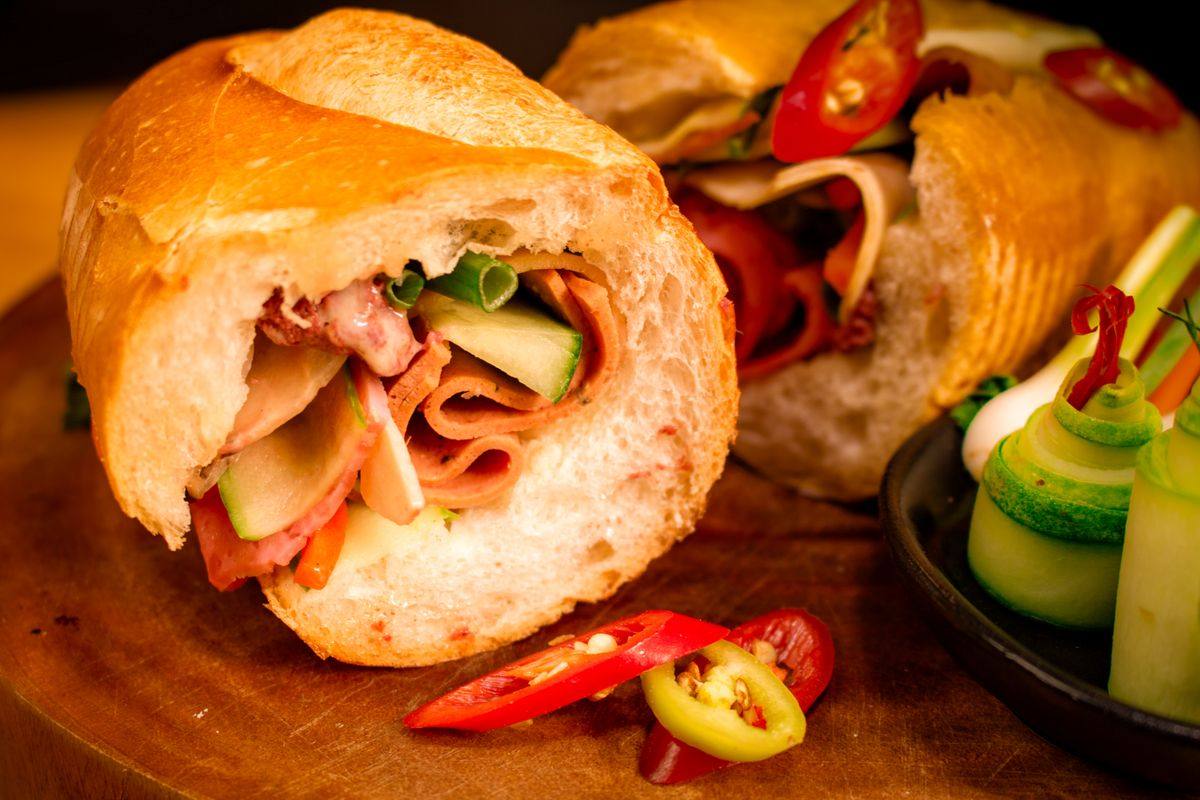
Direct answer: Banh mi Hanoi is a crisp Vietnamese baguette sandwich layered with homemade pâté, cold cuts or roast pork, pickled daikon and carrot, cucumber, coriander, and chili. Hanoi’s version is special for its rich, peppery liver pâté and less-sweet balance, making this French-Vietnamese classic a bold northern street snack.
What makes the Hanoi version different
Direct answer: Saigon’s version leans sweet, but banh mi Hanoi with butter and mayonnaise, but Hanoi keeps it savory and pâté-forward: a sharper crust from shorter-baked baguettes, generous pork liver pâté, and a pickled-vegetable crunch that cuts the richness. Northern vendors favor simplicity — fewer fillings, bolder seasoning — so the pâté does the talking.
The baguette arrived with the French in the late 19th century, but what Hanoi did with it is entirely Vietnamese. The northern sandwich is built around one ingredient above all: homemade pork liver pâté, whipped smooth, seasoned with pepper, and spread thick. Around it go thin slices of Vietnamese cold cuts or roast pork, a tangle of pickled daikon and carrot, cucumber spears, coriander, and a slick of chili — never the heavy butter-and-mayo layer you’ll find down south.
Hanoians treat banh mi Hanoi as a working breakfast. The bánh mì’s Franco-Vietnamese history explains the baguette itself — a colonial legacy perfected by Saigon and Hanoi bakers alike. Vendors near office districts and markets assemble them in under a minute, wrapping each in paper for commuters to eat on the go. Order “pâté” style and you’ll get the purist version; ask for “thập cẩm” (mixed) and the vendor piles on everything they have. Either way, the northern rule holds: savory first, sweet barely at all.
How much does it cost in Hanoi
Direct answer: In Hanoi, a sandwich typically costs 20,000–50,000 VND (~$0.75–1.90) depending on fillings and location, based on September 2026 price data. A classic pâté-and-cold-cut sandwich from an Old Quarter stall sits at the lower end; premium spots with French-style charcuterie push the price up.
| Type | Price (VND) | ~USD |
|---|---|---|
| Classic pâté & cold cuts (Old Quarter stalls, e.g. Banh Mi 25) | 25,000–40,000 | $0.95–1.50 |
| Old-school family shops (Banh Mi Pho Hue, Banh Mi Ba Dan) | 20,000–30,000 | $0.75–1.15 |
| Premium French-style charcuterie (Banh Mi Nguyen Sinh, 17–19 Ly Quoc Su) | 40,000–70,000 | $1.50–2.65 |
| General range across Hanoi | 20,000–50,000 | $0.75–1.90 |
Street prices were collected in September 2026; confirm at the counter, as tourist-area stalls can charge a little more than neighborhood ones.
Want to taste the real thing with a local? Message us on WhatsApp or email us and we’ll point you to the right counters — and the honest truth about learning to make it yourself.
Where to eat banh mi in Hanoi
Direct answer: Hanoi’s best-known banh mi Hanoi counters cluster in the Old Quarter, and three names come up in nearly every tourist guide: Banh Mi 25 for the classic tourist-friendly choice, Banh Mi Pho Hue for spicy homemade pâté, and Banh Mi Ba Dan, a family shop running since 1979.
- Banh Mi 25 — 25 Hang Ca, Hoan Kiem. The tourist-famous counter: fast, consistent, English-friendly, with sandwiches at 25,000–40,000 VND. It’s the safest first sandwich in Hanoi — not the most adventurous, but reliably good.
- Banh Mi Pho Hue — 118A Pho Hue, Hai Ba Trung. Known for its spicy homemade pâté at 25,000–30,000 VND. This is the one we send people who already like it and want the bolder, peppery northern version.
- Banh Mi Ba Dan — 34 Lo Su, Hoan Kiem. A family-run shop since 1979, charging 20,000–30,000 VND. Old-school, no-frills, and the kind of place where the recipe hasn’t changed in decades — that’s exactly the point.
One more worth knowing: Banh Mi Nguyen Sinh (17–19 Ly Quoc Su) does a pricier French-style version with proper cold cuts at 40,000–70,000 VND — closer to a Parisian jambon-beurre with Vietnamese pickles than a street sandwich.
Learn to cook it in Hanoi
Direct answer: We checked every major Hanoi cooking class in our research, and none lists it on a standard menu — it’s a street-food staple that vendors perfect over decades, not a typical classroom dish. For a hands-on version, ask about private or custom menus: Hidden Hanoi and Chef Duyen both tailor menus to guest requests.
Here’s the honest picture: the sandwich is assembled, not really cooked. The hard parts — baking a proper baguette with that shattering crust, and making pork liver pâté worth spreading thick — are bakery and charcuterie skills that don’t fit a 3–4 hour tourist class. That’s why Hanoi’s schools focus on dishes like bun cha, pho, and nem ran, where the techniques transfer to your home kitchen.
If you’re set on learning it, you have two realistic options. Hidden Hanoi’s cooking class runs customizable menus at its Tay Ho villa, so a session may be possible as a private request. Chef Duyen’s home cooking class also tailors menus to guests. Whether either can actually teach it — including the baguette and pâté from scratch — is; ask before you book, and don’t assume it’s on the standard menu.
FAQ
Is banh mi Hanoi different from Saigon banh mi?
Yes, noticeably. Hanoi’s version is savory and pâté-forward with pickled vegetables and little sweetness. Saigon’s tends to be richer and sweeter, with more butter, mayonnaise, and sometimes extras like fried egg or Chinese sausage. If you try both, you’ll taste the north–south divide in a single bite.
How much should I pay for banh mi Hanoi?
Expect 20,000–50,000 VND (~$0.75–1.90) for a standard sandwich, based on September 2026 prices. Classic Old Quarter stalls charge 25,000–40,000 VND; old family shops can be as little as 20,000 VND. Anything far above 50,000 VND should come with premium French-style charcuterie to justify it.
Can I learn to make banh mi in a Hanoi cooking class?
Not on any standard class menu we researched — it is a street-vendor craft built on baguette baking and pâté making, not typical classroom fare. Your best shot is a private or custom menu request: Hidden Hanoi offers customizable menus and Chef Duyen tailors menus to guests, but confirm it specifically before booking.
What fillings are most traditional in a banh mi Hanoi?
The northern classic is pork liver pâté plus Vietnamese cold cuts (gio lua, cha), with pickled daikon and carrot, cucumber, coriander, and chili. Roast pork (thit quay) is another local favorite. Hanoians keep it simple — the pâté is the star, and everything else is there to cut its richness.
Is banh mi a breakfast food or an all-day food in Hanoi?
Mostly breakfast and lunch. The best counters sell out by midday, and many close in the afternoon. If a stall is still assembling sandwiches at 3pm, it may not be at its freshest — go in the morning, when the baguettes are still warm from the oven.
Ready to cook Vietnamese food for real? It may be a vendor’s craft, but dishes like bun cha, pho, and nem ran are made for the classroom. Message us on WhatsApp or email us and we’ll match you with the right class.
Related dishes
- Nem Ran (Vietnamese Fried Spring Rolls) — Hanoi Guide: the crisp pork-and-wood-ear rolls that share the bun cha table — and the most-taught dish in Hanoi cooking classes.
- Bun Bo Nam Bo — Hanoi Guide: Hanoi’s famous dry vermicelli bowl with stir-fried beef — another southern-named, Hanoi-perfected classic.