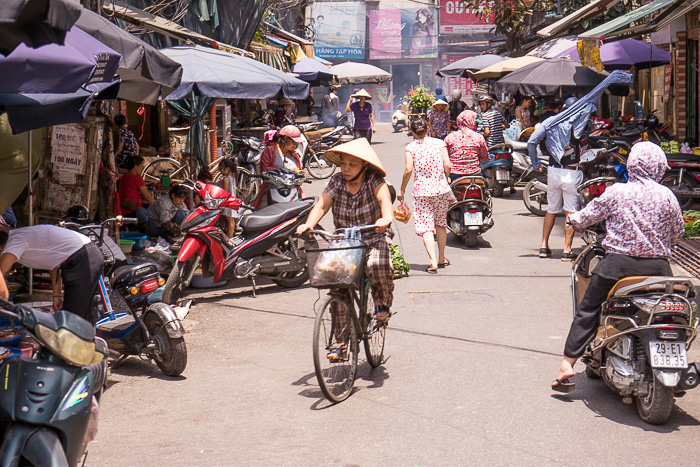
Direct answer: Dong Xuan Market is Hanoi’s largest covered market — built by the French in 1889 with a 6,500 m² hall just 600 metres north of Hoan Kiem Lake. Come before 9:00 AM and you’ll share the aisles with chefs buying the day’s produce, herbs, and spices for cooking classes. Morning is the only time to see it as a working food market, not a souvenir stop.
See it the way chefs do: several Hanoi cooking classes start with a guided market run before the aprons come on. Message us on WhatsApp or email us and we’ll match you with a class that includes a real morning market visit.
In this guide
- What Is Dong Xuan Market?
- 137 Years of Trading: A Short History
- A Chef’s Morning at Dong Xuan Market, Hour by Hour
- The Ingredient Tour: What Chefs Actually Buy Here
- From Market to Kitchen: Cooking Classes That Start Here
- How to Visit Dong Xuan Market Like a Chef, Not a Tourist
- Key Takeaway
- Conclusion
- Frequently Asked Questions
What Is Dong Xuan Market?
Direct answer: Dong Xuan Market (Chợ Đồng Xuân) is Hanoi’s largest covered market, a three-floor, 6,500 m² wholesale-and-retail hall at the northern edge of the Old Quarter, on the corner of Hang Khoai and Dong Xuan streets. It sells everything from fresh produce and dried goods to clothing and fabrics — and it has operated on this spot, in some form, since 1889.
If you arrive at 8:00 AM, Dong Xuan Market is a food market. Trucks and motorbikes unload baskets of morning glory, bundles of dill, crates of tofu, and live crabs along the ground floor while wholesale buyers — restaurant owners, street-food vendors, and cooking class chefs — haggle over the day’s stock. The famous five-arch facade faces the street, and behind it the hall hums with the particular music of Vietnamese commerce: bargaining voices, chopping boards, the hiss of a broth pot on a coal stove.
Arrive at noon and it’s a different place. Many stallholders slip away for lunch or nap behind their counters (a well-known habit worth planning around), and the hall settles into a sleepy, echoing rhythm. The food stalls on the upper floors still run, but the energy of the morning is gone. For food travelers, the lesson is simple: Dong Xuan Market rewards early risers.
137 Years of Trading: A Short History
Direct answer: In 1889, the French administration closed the Old Quarter’s two older marketplaces on Hang Duong and Hang Ma streets and built Dong Xuan Market in their place — one of Hanoi’s first great colonial buildings, alongside the nearby Long Bien Bridge. Fire nearly destroyed it in 1994; it was rebuilt in its original form and remains the capital’s largest covered market.
The numbers tell the scale of the original construction: about 6,500 m² under a corrugated galvanized-iron roof, with five entrance arches corresponding to five domes, each 19 metres high and 25 metres wide. The market was built just 600 metres north of Hoan Kiem Lake, anchoring the northern edge of the 36-street Old Quarter.
The history wasn’t all commercial. In February 1947, at the start of the First Indochina War, fierce fighting between Viet Minh and French forces took place around the market; a memorial near the main gate, erected in 2005, commemorates it. And in 1994, a disastrous fire wiped out roughly 4.5 million US dollars’ worth of stock before the market was partially rebuilt in its original style. The ward around it is even named after the market — Dong Xuan ward — and about half of its households trade in some form, according to Wikipedia’s history of Dong Xuan Market.
A Chef’s Morning at Dong Xuan Market, Hour by Hour
Direct answer: A typical chef’s market run starts at 7:00 AM with wholesale unloading, moves to fresh produce and herbs by 8:00, covers proteins and spices by 9:00, and wraps with a street breakfast by 9:30. Most Hanoi cooking classes with market tours follow exactly this rhythm — for example, one well-known class checks guests in at 8:45 and begins the market visit at 9:00 sharp.
Here is how the morning unfolds, pieced together from real class itineraries and the market’s daily rhythm:
| Time | What’s happening | Why it matters |
|---|---|---|
| 7:00 – 7:30 | Wholesale unloading: trucks and motorbikes pile crates of greens, herbs, and seafood along the ground floor. | The freshest stock of the day arrives first — chefs shop now or compete for it later. |
| 7:30 – 8:30 | Produce buying: chefs test herbs by smell, snap morning glory for crispness, choose tofu made that dawn. | This is the sensory part no recipe book can teach — and the reason classes do market tours. |
| 8:30 – 9:00 | Proteins and spices: shrimp, pork, fish; then the dried-goods lanes — star anise, dried shrimp, mushrooms, noodles. | The dry pantry is where Hanoi flavor hides: smell before you buy. |
| 9:00 – 9:30 | Breakfast break: bun rieu, banh cuon, or pho at the stalls on the market’s south side. | Chefs eat standing up; the market’s own food stalls are a mini tour of Hanoi breakfasts. |
| 9:30 – 10:00 | Back to the kitchen: ingredients sorted, the class’s cooking session begins. | From stall to cutting board in under an hour — that is the point of the whole morning. |
The Ingredient Tour: What Chefs Actually Buy Here
Direct answer: Chefs come to Dong Xuan Market for five things: leafy greens and herbs, tofu and fresh noodles, pork and seafood, dried spices and mushrooms, and the pantry staples (fish sauce, rice paper, dried shrimp) that define Hanoi cooking. The rule is always the same: touch, smell, and taste before paying.
- Herbs and greens: dill (a Hanoi obsession — it goes into cha ca and canh chua), Vietnamese coriander, perilla, morning glory, banana flower. Chefs rub a leaf between their fingers; if the scent is weak, they walk on.
- Tofu and noodles: silken tofu delivered at dawn, fresh rice noodles and banh cuon sheets. Freshness is measured in hours here.
- Proteins: pork belly and shoulder for bun cha, freshwater fish for cha ca, shrimp for nem ran. Ask for cuts by dish name and vendors know exactly what you need.
- The dry-goods lanes: star anise, cinnamon, cardamom, dried shiitake, wood ear mushrooms, dried shrimp, rice paper. This is where pho broth is born — a bag of spices that costs less than a coffee.
- Pantry staples: fish sauce in every grade, shrimp paste, fermented rice. Chefs taste fish sauce like wine; the first-press bottles rarely sit on the front shelf.
A practical note from the aisles: many stalls sell the same goods, so chefs buy relationships, not just ingredients. The vendor who saves you the best dill is worth more than a 5,000-dong discount.
From Market to Kitchen: Cooking Classes That Start Here
Direct answer: Several Hanoi cooking classes build their whole experience around a morning market tour. Rose Kitchen starts the day at a local market (Chợ Ngọc Hà), then runs a 9:00 AM–1:30 PM class covering four dishes. Apron Up checks guests in at 8:45, visits the market at 9:00, starts cooking at 10:00, and serves lunch at 12:30. If the market matters to you, book a class that lists the market tour in its itinerary — not all of them do.
Not every “cooking class with market tour” is equal. Some classes visit a small neighborhood market for fifteen minutes of photos; others spend a full hour teaching you to pick herbs, bargain, and spot the difference between good and great fish sauce. When you compare, look at three things: how long the market visit lasts, whether the chef shops for the actual class menu there, and whether the itinerary names the market.
Two strong options on our listings:
- Apron Up cooking class — the market trip is baked into the morning: arrival and check-in at 8:45, market visit at 9:00, cooking from 10:00, lunch and graduation at 12:30.
- Rose Kitchen vs Apron Up: which class fits you? — our head-to-head comparison of Hanoi’s two most-booked classes, including how each handles the market visit.
💡 Guide tip: If you want the Dong Xuan Market morning specifically, ask when you book — some classes visit smaller neighborhood markets instead. Our Old Quarter cooking class location guide maps which classes are closest to Dong Xuan Market (it’s a 10-minute walk from most Old Quarter kitchens), and our first-timer’s guide to Hanoi cooking classes covers what else happens on the day.
How to Visit Dong Xuan Market Like a Chef, Not a Tourist
Direct answer: Go before 9:00 AM, bring small cash, bargain with a smile when no fixed price is posted, skip the clothing floors unless you love wholesale chaos, and eat breakfast at the south-side stalls. On Friday, Saturday, and Sunday evenings, the streets outside become a night market extension.
- Timing: Before 9:00 AM for the food; midday is the dead zone (stallholders lunch or nap). Entrance is free and the hall is open all day.
- Bargaining: If there’s no fixed price sign, offer lower with a smile — vendors expect it and often reward it. If the price is printed, it’s fixed.
- Skip the souvenir hunt: Dong Xuan Market is aimed at Hanoians, not tourists. The clothing and toy floors are wholesale chaos; the food is the attraction.
- Eat the edges: The south side has a street-food alley; the north side has open-air restaurants. Both beat the upper-floor food court for atmosphere.
- Weekend nights: On Friday, Saturday, and Sunday evenings, traffic shuts down around the market and the Dong Xuan night market spills onto the streets with tourist-oriented stalls and more street food.
- Combine it: Dong Xuan Market sits 600 metres north of Hoan Kiem Lake — pair it with a lake walk and the Old Quarter streets in one morning.
Key Takeaway
Dong Xuan Market is two markets in one: a working food hall before 9:00 AM and a sleepy wholesale maze by noon. Go early, follow the chefs, and the market becomes the best free cooking lesson in Hanoi — then book a class with a real market tour to cook what you just learned to buy.
Conclusion: The Market Is the First Lesson
Every great Hanoi dish starts as a decision at a market stall — which dill, which shrimp, which bag of star anise. Dong Xuan Market has hosted those decisions since 1889, and watching chefs make them at 8:00 AM teaches more about Vietnamese cooking than an hour of chopping ever could. Walk the aisles early, eat breakfast on the south side, and if the market bug bites, turn the morning into a skill: book a class that starts where the chefs start.
Ready to cook what you saw at the market? Message us on WhatsApp or email us — tell us your dates and we’ll match you with a Hanoi cooking class that includes a morning market tour.
Frequently Asked Questions
Where is Dong Xuan Market in Hanoi?
Dong Xuan Market sits at the corner of Hang Khoai and Dong Xuan streets in Hoan Kiem district, at the northern edge of the Old Quarter — about 600 metres north of Hoan Kiem Lake and a 10-minute walk from most Old Quarter cooking class kitchens.
What time should I visit Dong Xuan Market?
Before 9:00 AM for the full food-market experience: wholesale unloading, the freshest produce, and chefs doing their daily shopping. Around midday many stallholders leave for lunch or rest, and the hall goes quiet. It’s open all day and entry is free.
Is Dong Xuan Market good for souvenirs?
Honestly, no — it’s a wholesale market aimed at Hanoians, with clothing, fabrics, and household goods in bulk. The food (fresh produce, dried goods, spices) and the atmosphere are the real attractions for travelers.
Can I bargain at Dong Xuan Market?
Yes, when no fixed price is posted. Offer a lower price with a smile and vendors usually meet you partway. Stalls with printed price tags are fixed-price.
Which Hanoi cooking classes include a market tour?
Several do, but check the itinerary before booking. Rose Kitchen includes a local market visit before its 9:00 AM–1:30 PM class; Apron Up runs a market trip at 9:00 ahead of a 10:00 cooking start. See our Rose Kitchen vs Apron Up comparison for how each handles the market visit.
Is there a night market at Dong Xuan?
On Friday, Saturday, and Sunday evenings, the streets around Dong Xuan Market close to traffic and become a night market extension with tourist-oriented stalls, souvenirs, and street food.
Sources: Dong Xuan Market history and dimensions per Wikipedia (Đồng Xuân Market) (French construction 1889, 6,500 m², five 19 m × 25 m domes, 1947 battle, 1994 fire); market layout and visitor tips cross-checked with Lonely Planet and Expedia guides; class itineraries per Rose Kitchen listings on Traveloka/Pelago/Klook and Apron Up itinerary pages, all accessed October 2026. Prices and schedules are research snapshots as of October 2026.