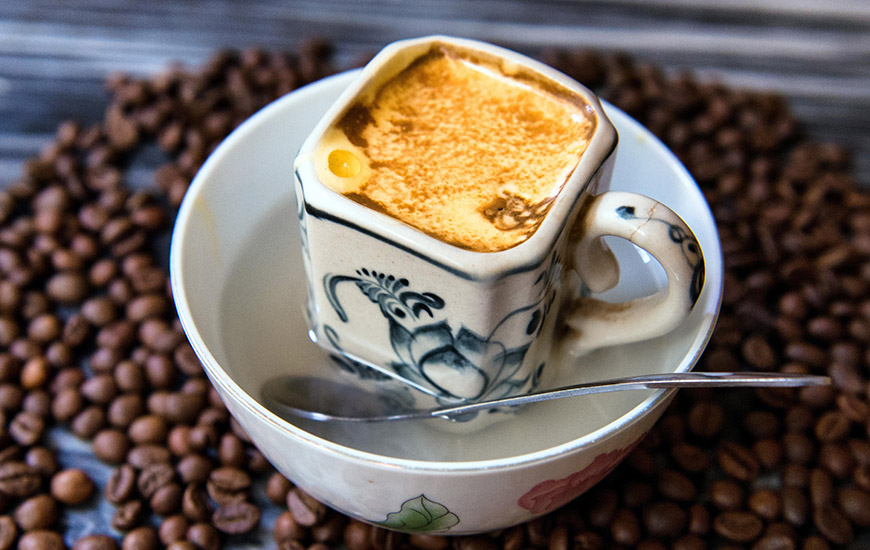
Direct answer: Egg coffee (cà phê trứng) was invented in Hanoi in 1946 by bartender Nguyen Van Giang, who whisked egg yolk with sugar and condensed milk as a substitute for scarce fresh milk during the First Indochina War. He served it at the Metropole Hotel, then opened Café Giang — still family-run today. Read on for the full egg coffee history.
Key takeaway: Every cup holds 80 years of egg coffee history. A 1946 milk shortage forced a bartender to replace missing milk with whisked egg yolk — and the result outlasted wars, reunification, and eight decades of change. The original recipe is still poured by the inventor’s family at Café Giang, 39 Nguyen Huu Huan.
Want to taste 80 years of history in one cup? Message us on WhatsApp or email us or email us and we will match you with a class that fits your dates.
In this guide
- Who invented egg coffee in 1946?
- Why was milk scarce? Hanoi at the start of the First Indochina War
- What did Hanoi coffee culture look like before egg coffee?
- How Café Giang kept the 80-year-old secret
- Egg coffee history after 1946: from the Old Quarter to the world
- How to taste 80 years of history in Hanoi
- Ready to taste the story yourself?
- Frequently asked questions
Who invented egg coffee in 1946?
Direct answer: Egg coffee was invented in 1946 by Nguyen Van Giang, a bartender at Hanoi’s Metropole Hotel (now the Sofitel Legend Metropole). Facing a wartime shortage of fresh milk, he whisked egg yolks with sugar and sweetened condensed milk to recreate the creamy foam of the cappuccinos he used to make — and cà phê trứng was born.
Giang had spent years crafting European-style coffee with fresh milk and cream for the Metropole’s foreign guests. But as the First Indochina War intensified and fresh dairy became almost impossible to find in Hanoi, he refused to serve an inferior cup. Experimenting in the hotel bar, he discovered that egg yolks, beaten with sugar and condensed milk, whipped into a foam remarkably close in richness and texture to steamed dairy cream.
He poured that golden foam over strong Vietnamese robusta — and the drink was an instant sensation, indulgent yet affordable for ordinary Hanoians. The invention was so popular that Giang eventually left the hotel to open his own shop, Café Giang in the Old Quarter, where the family still serves the original recipe today. This is the founding moment of egg coffee history.
Why was milk scarce? Hanoi at the start of the First Indochina War
Direct answer: In December 1946, war broke out between France and the Viet Minh, beginning the First Indochina War (1946–1954). Supply chains collapsed, and fresh milk — already a rare luxury in 1940s Hanoi — became nearly unobtainable, forcing café owners to improvise or close. It is the crisis that starts the egg coffee history.
Fresh dairy had never been part of everyday Vietnamese life. Cows were working animals, not dairy animals, and the milk that existed in colonial Hanoi came through fragile French supply networks. When the war disrupted those networks, even hotels like the Metropole could not reliably source it.
Giang’s own son, Nguyen Van Dao, who runs Café Giang today, put it plainly in an interview with Viet Nam News: at the time, milk was “rare and very expensive,” and his father simply “couldn’t afford it.” So he invented a drink without it — and guests loved it so much that some said they liked it even more than milk coffee.
What did Hanoi coffee culture look like before egg coffee?
Direct answer: Before 1946, Hanoi’s coffee culture was a French colonial import: grand hotel bars and sidewalk cafés that began as the domain of French officials and the Vietnamese elite, then gradually became part of everyday city life. Fresh milk was scarce even in peacetime, so sweetened condensed milk became the default — the ancestor of today’s cà phê sữa đá.
The French had introduced coffee to Vietnam in the mid-19th century, planting it in the Central Highlands. By the 1940s, the café was already a Hanoi institution — a place to linger over a slow-dripped phin filter while the city went by. But milk coffee was always a compromise: without reliable fresh milk, condensed milk did the job, and Vietnamese drinkers developed a taste for coffee that was strong, dark, and unapologetically sweet.
Giang’s genius was working inside that tradition rather than against it. He did not invent coffee in Hanoi — he invented a new cream for it, one that turned a wartime constraint into the city’s signature drink — the most creative chapter of egg coffee history.
How Café Giang kept the 80-year-old secret
Direct answer: Café Giang has been run by the inventor’s family since 1946, and it still guards the original formula. Nguyen Van Giang’s son, Nguyen Van Dao, runs the café on Nguyen Huu Huan Street in the Old Quarter using what he calls the family’s secret recipe — one no rival has ever quite matched.
Inside the tiny, always-crowded café, a photograph of Nguyen Van Giang hangs on the wall behind the counter — a tribute to the man who turned scarcity into an icon. His son told Viet Nam News that imitators have tried for decades, but “no one has been able to achieve the same flavor.” The family keeps its own formula, and Dao says he is using exactly the recipe his father passed down, preserving it as the old man asked. That secrecy is part of what makes egg coffee history so hard to verify — and so fun to retell.
The lineage spread, too: Dinh Cafe, overlooking Hoan Kiem Lake, is also run by the Giang family — same roots, calmer setting. Two cafés, one family recipe, eight decades of egg coffee history.
Egg coffee history after 1946: from the Old Quarter to the world
Direct answer: For decades, it stayed a Hanoi regional specialty — then tourism, social media, and international press carried it worldwide. CNN covered the drink around its 70th anniversary, it was served to 3,000 journalists at the 2019 DPRK–US Summit in Hanoi, and “new wave” cafés now pour egg cocoa and egg matcha built on the same 1946 foam.
Chef Hoàng Tùng of Hanoi’s acclaimed T.U.N.G Dining captured why the story resonates beyond taste: the drink, he said, “represents resilience” — proof that Vietnamese culture has always known how to turn difficulty into beauty. That resilience narrative is exactly what made the drink travel. It is the chapter of egg coffee history that turned a regional specialty into a global icon.
Key dates in egg coffee history:
| Year | Milestone |
|---|---|
| 1946 | Nguyen Van Giang invents the drink at the Metropole during the First Indochina War’s milk shortage |
| Late 1940s | Giang opens Café Giang in the Old Quarter; the family recipe begins its 80-year run |
| 2016 | CNN features the drink around its 70th anniversary, introducing it to a global audience |
| 2019 | Egg coffee is served to 3,000 journalists at the DPRK–US Summit in Hanoi |
| 2020s | “New wave” cafés, egg cocoa and egg matcha variants, and social media fame take it worldwide |
Today you can find versions of it from Ho Chi Minh City to London and New York — but purists will tell you the Hanoi original, in a small cup sitting in a bowl of warm water, is still the one to judge them all by. Our egg coffee guide with 2026 prices and cafés shows where to drink the real thing — the living end of egg coffee history.
How to taste 80 years of history in Hanoi
Direct answer: Drink the original first: head to Café Giang at 39 Nguyen Huu Huan, the 1946 birthplace run by the inventor’s family, where a cup costs around 30,000–55,000 VND. Then pick one view café — Dinh Cafe or Cafe Pho Co — for the full experience. Two cups in one afternoon is entirely reasonable.
The ritual matters. Don’t stir it like a latte: spoon through the golden foam and let the bitter robusta rise through the sweetness. At Giang, the cup often sits in a bowl of warm water to keep the foam from cooling — exactly as it has been served for generations.
Want to take the story home with you? The drink is taught as a dessert segment in several of Hanoi’s best cooking classes — including Rose Kitchen and Apron Up, where you can compare programs in our Rose Kitchen vs Apron Up review. Learning the whisking technique from a Hanoi chef is the best souvenir there is. See our guide to booking a cooking class in Hanoi directly to get the best price.
Planning your Hanoi food trip? Message us on WhatsApp or email us or email us and we will match you with a class that fits your dates.
Ready to taste the story yourself?
Eighty years ago, a bartender with no milk changed Hanoi’s mornings forever — and that is the whole of egg coffee history in one small cup. The foam he invented still crowns cups in the same Old Quarter alleys — and the family still won’t share the exact formula. Come drink the original, learn to whisk it in a Hanoi cooking class, and take home a story worth more than any souvenir.
Frequently asked questions
Who invented Vietnamese egg coffee?
Egg coffee history begins with Nguyen Van Giang, a bartender at Hanoi’s Metropole Hotel, who invented the drink in 1946. Facing a wartime milk shortage during the First Indochina War, he whisked egg yolk with sugar and condensed milk as a milk substitute — then opened Café Giang, still family-run today.
Does egg coffee taste like egg?
No — and that surprises everyone. Properly whisked, the yolk disappears into a sweet, custardy foam that tastes like liquid tiramisu or crème brûlée. If you can taste egg, the whisking was rushed. At the original Café Giang, you won’t taste egg at all.
Is the original Café Giang still run by the inventor’s family?
Yes. Nguyen Van Giang’s son, Nguyen Van Dao, runs Café Giang on Nguyen Huu Huan Street in the Old Quarter, using the original family recipe. Dinh Cafe by Hoan Kiem Lake is also run by the Giang family.
How did egg coffee become famous worldwide?
For most of egg coffee history, it stayed a Hanoi regional specialty; then international media — including CNN around its 70th anniversary — plus tourism and social media carried it global. A milestone moment: it was served to 3,000 journalists at the 2019 DPRK–US Summit in Hanoi.
Where can I drink the original 1946 recipe in Hanoi?
At Café Giang, 39 Nguyen Huu Huan in the Old Quarter — the birthplace, run by the inventor’s family since 1946. Expect to pay 30,000–55,000 VND. See our egg coffee guide for more cafés and 2026 prices.
Can I learn to make egg coffee in a Hanoi cooking class?
Yes — it’s taught as a dessert segment in most Hanoi cooking classes, including Rose Kitchen, Apron Up, and Hidden Hanoi. Check our 10 best cooking classes in Hanoi ranking to compare programs and prices before you book.
Sources
- Parade — Vietnamese Egg Coffee: History, How To Make
- Viet Nam News — A style honed in VN that’s becoming a real egg-stravaganza
- Travel+Leisure Asia — Have You Tried Egg Coffee in Vietnam? It Tastes Like ‘Liquid Tiramisu’
- Hanoi Times — Egg coffee, a must to try when in Hanoi
- Wikipedia — Egg coffee
- AsiaTourAdvisor — Hanoi Egg Coffee on CNN: the secret of a 70-year-old coffee