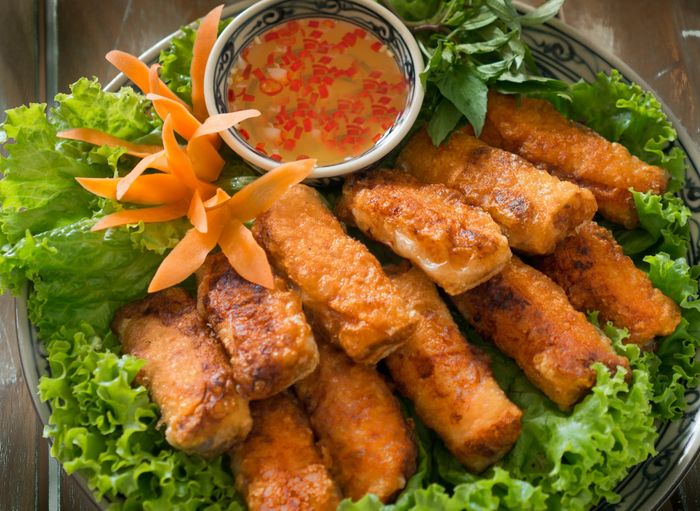
Direct answer: This nem ran recipe makes 16 golden, shatteringly crisp Hanoi-style fried spring rolls: thin rice-paper wrappers around a classic filling of minced pork, wood-ear mushroom, and glass noodles, finished with a double fry so they stay crunchy long after they leave the pan. Total time is about 1 hour 15 minutes, and the batch serves 4 as a generous appetizer. In the north of Vietnam the dish is called nem ran; in the south the same roll is known as cha gio.
TL;DR — Nem Ran at a glance
- Total time: ~1 hour 15 minutes (35 min prep + 20 min rolling + 20 min frying)
- Makes: 16 rolls, serves 4
- Difficulty: Medium — the rolling takes a few practice tries
- Jump to the recipe
In this guide
- Why this nem ran recipe works
- Ingredients for crispy nem ran
- How to make nem ran, step by step
- The double-fry secret (why two fries, not one)
- Common nem ran mistakes & fixes
- How to serve nem ran
- FAQ
Craving the real thing first? Nem ran is taught in nearly every Hanoi cooking class — rolling rice paper is one of the few skills that is genuinely hard to learn from video alone. Message us on WhatsApp or email us and we will match you with a class that nails the crispy roll.
Why this nem ran recipe works
Direct answer: This nem ran recipe works because it treats crispiness as a technique, not a hope: thin Hanoi-style rice paper, a tight roll with no air pockets, and two separate fries — the first at medium heat to cook the filling through, the second hot to blister the wrapper. That sequence is what separates restaurant-crisp rolls from the soggy ones most home cooks get from a single fry.
The Hanoi version stays deliberately slim. Unlike bulked-up southern rolls stuffed with taro, the classic northern filling is lean — pork, wood-ear mushroom for chew, glass noodles for lightness, a little carrot and shallot — so the wrapper, not the filling, does the talking. Our Nem Ran dish guide covers the history and where to eat them; this recipe is the hands-on part: making them in your own kitchen with the same results.
Everything below follows the method taught in Hanoi cooking classes and documented by Vietnamese recipe developers: damp-cloth softening (never soaking) of the wrapper, a heaping tablespoon of filling per roll, and frying in small batches so the oil temperature never crashes.
Ingredients for crispy nem ran
Direct answer: The classic Hanoi filling needs ground pork, dried wood-ear mushrooms, dried glass noodles, carrot, shallot, egg as a binder, and simple seasoning — plus thin rice-paper wrappers and neutral oil for deep frying. No specialty equipment is required beyond a wide pan and a slotted spoon.
| Ingredient | Amount | Notes |
|---|---|---|
| Ground pork (80/20) | 300 g | Some fat keeps the filling juicy; lean pork turns dry |
| Dried wood-ear mushrooms | 15 g | Soak in hot water 10 minutes, then mince — the signature chew |
| Dried glass (cellophane) noodles | 50 g | Soak in room-temperature water ~15 minutes; snip into 3-cm pieces |
| Carrot | 1 medium (about 100 g) | Grated fine; adds sweetness and color |
| Shallots | 2 | Minced; onion works in a pinch |
| Eggs | 1 whole + 1 white | The binder — holds the filling together so it does not crumble |
| Fish sauce | 1 tbsp | Seasoning backbone of the filling |
| Salt, black pepper, sugar | 1/2 tsp / 1 tsp / 1/2 tsp | Season lightly — the dip brings the salt later |
| Thin rice-paper wrappers (banh trang, ~16 cm) | 16–18 sheets | The thin northern style fries crispest; avoid thick taco-style rounds |
| Neutral frying oil | About 1 liter | Peanut, rice bran, or vegetable oil |
To serve: soft lettuce leaves, fresh herbs (mint, cilantro, perilla), and a bowl of nuoc cham dipping sauce (recipe below).
Ingredient notes from research (October 2026): Vietnamese recipe developers consistently use the same core trio — pork, wood-ear, glass noodles — with egg as the binder. Some southern versions add taro or jicama, but Hanoi keeps it lean, which is exactly why the Hanoi roll fries thinner and crunchier.
How to make nem ran, step by step
Direct answer: Mix the filling, soften each rice-paper sheet with a damp cloth, roll a heaping tablespoon of filling tight with no air pockets, then fry twice — first at medium heat (160–170°C) for 4–5 minutes until pale gold, rest 10 minutes, then again at 180–190°C for 2–3 minutes until deep golden. Serve immediately.
- Soak the dried ingredients. Cover the wood-ear mushrooms with hot water for 10 minutes and the glass noodles with room-temperature water for about 15 minutes. Drain well, then mince the mushrooms finely and snip the noodles into short 3-cm lengths with scissors. Squeeze out excess water — wet filling is the number-one cause of soggy rolls.
- Mix the filling. Combine the pork, mushrooms, noodles, grated carrot, minced shallots, egg, fish sauce, salt, pepper, and sugar in a large bowl. Mix in one direction until tacky, about 2 minutes, then let it rest 10 minutes so the seasoning distributes.
- Set up the rolling station. Lay a clean, damp kitchen towel flat on your work surface — this is your wrapper-softening tool. Keep the rice-paper sheets dry in their package until the moment you use them.
- Soften and roll. Place one sheet on the damp towel for a few seconds until just pliable (do not soak it — an over-wet sheet turns gummy and tears). Put a heaping tablespoon of filling in a line near the edge closest to you. Fold the two sides in, then roll away from you firmly and evenly, pressing out air pockets as you go. The roll should feel snug, not strangled. Repeat for all 16 rolls, covering finished ones with a dry towel so they do not stick together.
- First fry — cook through. Heat the oil to 160–170°C (a chopstick dipped in should release small, lazy bubbles). Fry in batches of 4–5, leaving space between rolls, for 4–5 minutes until pale gold. Lift out with a slotted spoon and drain on a wire rack or paper towel. Rest at least 10 minutes.
- Second fry — crisp. Raise the oil to 180–190°C. Return the rolls for 2–3 minutes until deep golden and audibly crackling. This second fry drives off surface moisture and blisters the wrapper into that signature shatter.
- Drain and serve immediately. Stand the rolls upright on a rack for a minute so steam escapes instead of softening the wrapper, then serve with lettuce, herbs, and nuoc cham while they still crackle.
The double-fry secret (why two fries, not one)
Direct answer: The first fry cooks the filling through and sets the wrapper at gentle heat; the resting period lets steam escape; the second fry at higher heat re-crisps the wrapper into a blistered, glassy crunch. A single hot fry burns the outside before the pork inside is done — that is the trap most home recipes fall into.
This is also the make-ahead trick Hanoi cooks use for parties. Fry once at medium heat, cool completely, and refrigerate; the next day, do the second fry from cold at 180–190°C and the rolls come out as crisp as fresh. They can even be frozen after the first fry and refried from thawed. Never skip the rest between fries — it is the quiet step that makes the crunch last on the table instead of going limp in five minutes.
One more rule from the test kitchen: never overcrowd the pan. Too many rolls at once crashes the oil temperature, and cool oil means greasy, limp wrappers. Four to five rolls per batch is the sweet spot for a standard home pan.
Want a chef watching your first roll? The rolling technique in this nem ran recipe — tight enough to fry without bursting, loose enough to stay crisp — takes most people a few supervised tries. WhatsApp us or email us and we will find you a Hanoi class that teaches it hands-on, market tour included.
Common nem ran mistakes & fixes
Direct answer: Almost every nem ran failure comes from four causes: oil that is too cool, an overcrowded pan, a wrapper that was soaked too long, or air trapped inside the roll. All four are fixable mid-cook once you know what to look for.
| Mistake | What you see | Fix |
|---|---|---|
| Oil too cool | Greasy, pale, limp rolls | Wait for 160–170°C on the first fry; test with a chopstick — lazy bubbles, not silence |
| Overcrowded pan | Uneven browning, soggy patches | Fry 4–5 rolls per batch; the oil temperature must recover between batches |
| Wrapper soaked, not dampened | Tears, gummy chew, rolls stick to the pan | Soften with a damp cloth for seconds only; the sheet should feel pliable, not wet |
| Air pockets in the roll | Rolls burst or balloon in the oil | Press air out as you roll; keep the filling compact and the roll snug |
| Rolled too far ahead | Finished rolls stick together and tear | Cover rolled nem with a dry towel and fry within 30 minutes, or do the first fry and hold |
How to serve nem ran
Direct answer: Serve nem ran hot with nuoc cham (fish-sauce dip), soft lettuce, and fresh herbs — wrap a roll in lettuce with herbs, dunk, and eat in two bites. In Hanoi they also arrive as the classic sidekick to a bowl of bun cha.
Quick nuoc cham (makes ~1 cup): dissolve 2 tablespoons of sugar in 4 tablespoons of warm water, then stir in 3 tablespoons of fish sauce, 2 tablespoons of fresh lime juice, 1 minced garlic clove, and sliced chili to taste. It should taste bright and balanced — sweet first, then salty, then sour.
The full Hanoi experience pairs these rolls with our Hanoi bun cha recipe — smoky grilled pork and cool noodles against hot crunch is the combination Hanoians order on autopilot. And if you want the drink that belongs on the same table, read the story of how egg coffee was born from 1946 milk scarcity.
Key takeaway: Crispiness is a three-step system — thin wrapper, tight roll, double fry. Get those three right and this nem ran recipe delivers rolls that shatter, stay crunchy on the table, and taste unmistakably Hanoi.
Ready to roll your own?
Nem ran is the highest-value skill on any Hanoi cooking class menu: the filling is simple, the technique is all in the roll, and nothing impresses guests back home like a platter of rolls that crackle. Practice this nem ran recipe once at home, then come learn the chef’s refinements — the damp-towel trick, the double-wrap for the ends, the oil-temperature read — in a real Hanoi kitchen. For planning help, see how to book a cooking class in Hanoi for less.
Book your Hanoi cooking class: Chat with us on WhatsApp or email us — tell us you read the Nem Ran Recipe article and we will match you with a class that teaches it best.
Frequently asked questions
Is nem ran the same as cha gio?
Essentially, yes — the same fried spring roll with different regional names. The north calls it nem ran, the south calls it cha gio. Hanoi’s version tends to be slimmer, with a lean pork, wood-ear mushroom, and glass noodle filling, while southern cha gio is often plumper with taro or jicama mixed in.
Can I make nem ran ahead of time?
Yes — this is where the double fry earns its keep. Do the first fry at 160–170°C, cool the rolls completely, and refrigerate for up to a day (or freeze for longer). When ready to serve, do the second fry at 180–190°C straight from the fridge; they come out as crisp as fresh.
Why did my nem ran turn out soggy?
The three usual suspects: oil that was not hot enough, too many rolls in the pan at once, or a filling that was too wet. Keep the first fry at 160–170°C, fry 4–5 rolls per batch, and squeeze the soaked noodles and mushrooms dry before mixing the filling.
Can I bake or air-fry nem ran instead of deep frying?
You can, but set expectations: rice-paper wrappers need hot oil to blister into that glassy crunch, so baked or air-fried versions come out drier and less shattering. If you air-fry, brush the rolls generously with oil and cook at 200°C, flipping once — closer to the real thing, though still not identical to the double fry.
What rice paper should I buy for nem ran?
Look for thin Vietnamese banh trang rounds, about 16 cm across, labeled for fried spring rolls — the thin northern style fries crispest. Avoid thick taco-style rice papers; they turn chewy instead of crackly no matter how you fry them.
Is this nem ran recipe gluten-free?
Nearly: rice-paper wrappers and glass noodles are naturally gluten-free. Just check your fish sauce label, as a few brands add wheat-derived ingredients. Use a certified gluten-free fish sauce and the whole recipe is gluten-free.
Sources: Filling ratios and double-fry technique cross-checked against Vietnamese recipe developers — Helen’s Recipes (helenrecipes.com), Delightful Plate (delightfulplate.com), and Gourmetpedia (gourmetpedia.net), research snapshot October 2026; regional background via Wikipedia’s cha gio article.