Crackly, golden, and gone in seconds — nem ran is the fried spring roll that shows up at nearly every Hanoi table, from family dinners to bia hơi joints. We, the Hanoi Cooking Class Team, consider it the single most useful dish you can learn in a Hanoi cooking class: the filling is simple, the technique is all in the roll, and nothing impresses guests back home like a platter of these. This guide covers what makes the Hanoi version different, what it costs, where to eat it, and which classes teach it best.
In this guide:
- What makes the Hanoi version different
- How much does it cost in Hanoi
- Where to eat them in Hanoi
- Learn to cook it in Hanoi
- FAQ
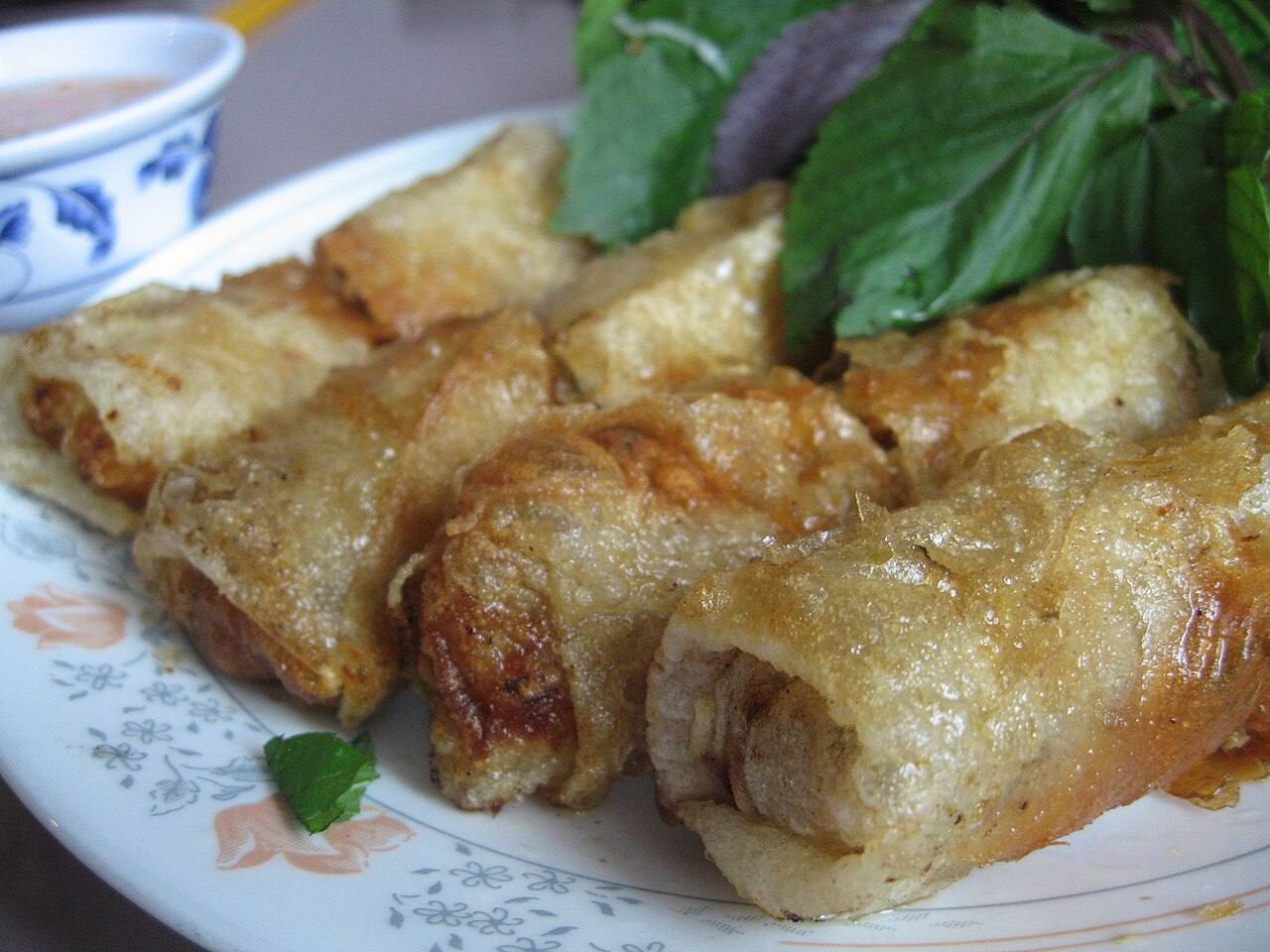
Direct answer: Nem ran (northern name for Vietnam’s fried spring rolls, called cha gio in the south) is a crisp rice-paper roll stuffed with minced pork, wood-ear mushroom, and glass noodles, deep-fried golden and eaten with sweet-sour nuoc cham. Hanoi’s version stands out for its thin, crackly rice-paper wrapper and the wood-ear bite that vendors rarely skip.
What makes the Hanoi version different
Direct answer: The Hanoi difference is the wrapper and the filling discipline: thin rice paper that fries crisp, and a classic mix of pork, wood-ear mushroom, and glass noodles — never the bulked-up southern fillings. Hanoians also eat nem as a partner dish, tucked beside a bowl of bun cha, so every roll is rolled slim to stay crunchy.
First, the name: in the north it’s nem ran; in the south, the same idea is cha gio. The Hanoi filling stays close to the classic — minced pork, wood-ear mushroom for chew, glass noodles for lightness, sometimes a little crab or shrimp when the cook is feeling generous. Southern versions tend to be fatter, with taro or jicama bulking things up; Hanoi keeps the roll slim so the wrapper does the talking.
That wrapper matters. Hanoi cooks use thin rice paper, briefly softened, rolled tight, and fried twice for maximum shatter. The classic way to eat them is as the partner to bun cha — a couple of rolls on the side of your grilled-pork noodle bowl — or wrapped in lettuce with herbs and dunked in nuoc cham, the sweet-sour fish-sauce dip that ties the whole northern table together.
How much does it cost in Hanoi
Direct answer: A single nem ran costs about 7,000 VND as a bun cha side order, based on 2026 street-food reporting. A full plate of fried spring rolls at a local shop typically runs 25,000–50,000 VND (~$0.95–1.90) — note our research flags this plate range as approximate, so treat it as a guide, not a fixed menu.
| Where | Price (VND) | ~USD |
|---|---|---|
| Single roll as a bun cha side | ~7,000 per roll | ~$0.25 |
| Plate of nem ran at a local shop (approximate range) | 25,000–50,000 | $0.95–1.90 |
They are one of Hanoi’s cheapest pleasures — a full plate costs less than a coffee in most Western cities. Prices move with pork costs, so confirm at the counter if you’re ordering for a group.
Learn to roll them yourself. Nem ran is taught in nearly every Hanoi cooking class — it’s the highest-value skill on any menu. Message us on WhatsApp or email us and we’ll match you with a class that nails the crispy rice-paper roll.
Where to eat nem ran in Hanoi
Direct answer: Nem ran doesn’t really have dedicated famous shops — it’s the classic side dish at bun cha counters and family cơm restaurants across Hanoi. Your most reliable route is ordering it alongside bun cha at any busy lunch counter, where rolls arrive hot and freshly fried.
Because nem ran is a supporting act rather than a headliner, the best strategy is to go where the fryers never stop. Any busy bun cha lunch counter — Bun Cha Dac Kim (74 Hang Quat) or Bun Cha Hanh Manh (1 Hang Manh) — serves nem ran as the standard side, and the rolls there are fried to order because the lunch crowd demands it. Family-style cơm restaurants across the Old Quarter also do excellent versions, usually as part of a shared spread.
Our honest note: the research named no verified standalone famous nem-only shop, so dedicated nem ran specialists are. But here’s the thing — you don’t need one. Order nem ran wherever Hanoians are already eating lunch, and you won’t go wrong.
Learn to cook it in Hanoi
Direct answer: Good news — nem ran is taught in nearly every Hanoi cooking class, and five schools in our research list it explicitly: Rose Kitchen, Apron Up, Chef Duyen, Daisy Hoang’s class, and Hidden Hanoi. If you take one dish home from class, make it this one — rice-paper rolling is hard to learn from video alone.
This is the dish where a class genuinely beats YouTube. Rolling rice paper tight enough to fry without bursting — but not so tight it turns gummy — takes a few supervised tries, and every chef we know has a trick for it (damp towel, double-wrap the ends, rest before frying). You’ll practice it hands-on and eat your homework.
- Rose Kitchen cooking class — nem (spring rolls) is a core dish alongside bun cha and egg coffee, taught at the Ba Dinh villa after the market tour.
- Apron Up cooking class — spring rolls appear on the 5-dish menu (Pho / Bun Cha / Spring Roll / Papaya Salad / Egg Coffee option) at 8 Gia Ngu in the Old Quarter.
- Chef Duyen’s home cooking class — fried spring rolls feature in both the Countryside and Hanoi Favourites menus, cooked at her home near Long Bien bridge.
- Daisy Hoang’s cooking class — choose spring rolls as one of your 3 dishes from 9 at 54 Hang Buom, with egg coffee to finish.
- Hidden Hanoi cooking class — nem ran is one of the 4 standard dishes (with bun cha, banana flower salad, and egg coffee) at the Tay Ho villa; vegetarian and vegan versions available.
FAQ
Is nem ran the same as cha gio?
Essentially, yes — same dish, different regional names. The north calls it nem ran, the south calls it cha gio. Hanoi’s version tends to be slimmer with a pork, wood-ear mushroom, and glass noodle filling, while southern cha gio is often fatter with taro or jicama. Order either name and you’ll get a fried spring roll.
Is nem ran vegetarian-friendly?
The classic Hanoi filling uses minced pork, so no — but vegetarian versions are easy and common. Several classes, including Hidden Hanoi, explicitly offer veg and vegan alternatives, swapping in mushrooms, tofu, and extra vegetables. At restaurants, look for “nem chay” (vegetarian spring rolls) on the menu.
How do you keep nem ran crispy?
Three rules from Hanoi cooks: roll the rice paper tight with no air pockets, fry twice (first at medium heat to cook through, then hot to crisp), and drain standing up so steam escapes instead of softening the wrapper. In class you’ll practice the rolling — that’s the part you can’t learn from reading.
What do you dip nem ran in?
Nuoc cham — the sweet-sour-salty fish-sauce dip with lime, sugar, garlic, and chili. Hanoians also wrap nem ran in lettuce with fresh herbs before dunking, which adds crunch and cuts the richness of the fried wrapper.
Why is nem ran always served with bun cha?
It’s the classic partnership: the smoky grilled pork and cool noodles of bun cha meet the hot crunch of a fried roll. Most bun cha counters fry nem to order as a side (about 7,000 VND a roll), so ordering “bun cha nem” gets you the full Hanoi lunch in one bowl.
Ready to roll? Nem ran is the most-taught dish in Hanoi’s cooking classes for a reason — it’s fun, fast, and endlessly useful back home. Message us on WhatsApp or email us and we’ll find your class.
Related dishes
- Banh Mi — Hanoi Guide: Hanoi’s crisp pâté-heavy baguette sandwich — the northern street snack worth planning breakfast around.
- Bun Bo Nam Bo — Hanoi Guide: the dry vermicelli bowl with stir-fried beef — a southern-named dish that Hanoi made its own.