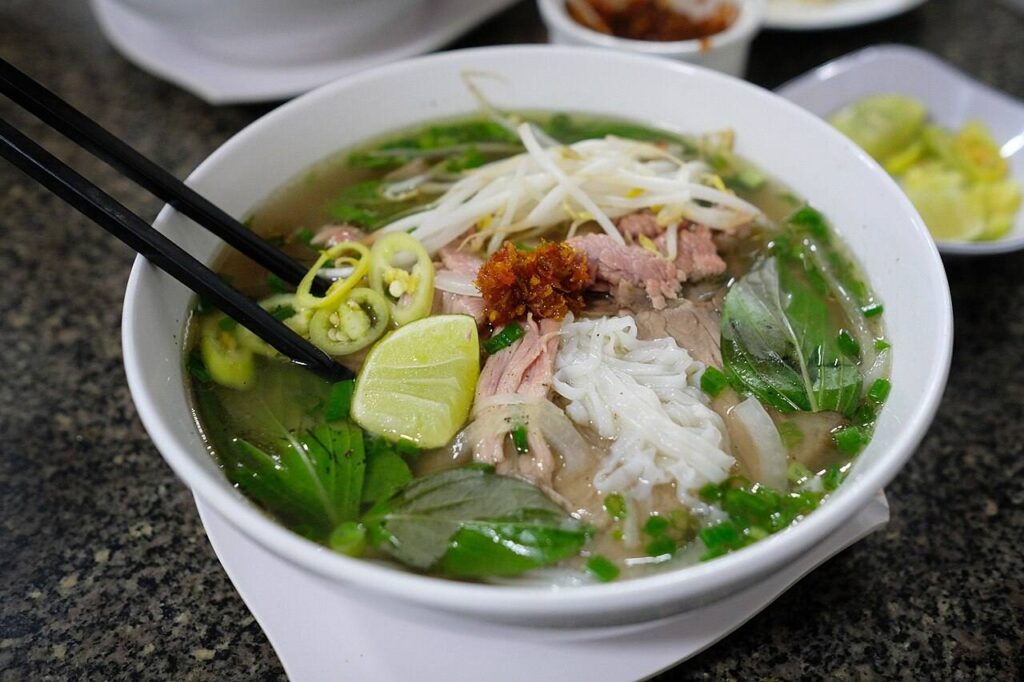
Authentic Hanoi Pho Bo Recipe: Clear Broth Secrets Step by Step
What if the bowl of phở you fell in love with on a Hanoi sidewalk could come out of your own kitchen? This Hanoi pho recipe is the one we teach in our kitchens: a crystal-clear beef broth, flat rice noodles, and paper-thin slices of beef — the northern style, exactly as Hanoi does it. No shortcuts that sacrifice flavor, no muddy broth, no guesswork.
Key takeaway: A crystal-clear phở broth comes down to three non-negotiables — parboil the bones for 10 minutes and discard the water, char the ginger and onion until blackened, and keep the pot at the barest simmer for 6–8 hours without ever letting it boil hard.
Direct answer: This authentic Hanoi phở bò recipe makes 4 servings of Vietnamese beef noodle soup with a clear, aromatic broth. Parboiled marrow bones simmer 6–8 hours with charred ginger, onion, and toasted spices; the broth is seasoned with fish sauce and rock sugar, then ladled over flat rice noodles, tender brisket, and paper-thin rare beef. Total time is about 8–9 hours, with roughly 45 minutes of active work.
In this guide
- What makes this Hanoi pho recipe different
- Choosing the right bones and beef
- Ingredients for 4 servings
- The clear-broth secrets
- Step-by-step instructions
- Common mistakes & how to fix them
- Seasoning, storing, reheating & serving
- Learn phở hands-on in Hanoi
- Conclusion
- Frequently asked questions
What makes this Hanoi pho recipe different
Direct answer: This recipe follows the Hanoi (northern) style: a clean, delicate broth with restrained seasoning and minimal garnishes — scallions, white onion, herbs, lime, and chili on the side. No hoisin sauce, no mountain of bean sprouts. If you want the full background on Hanoi vs. southern phở, prices, and where locals eat, read our complete Hanoi phở guide: what a bowl should cost and where locals eat first — then come back and cook.
Hanoi is where phở was born, and the northern bowl is defined by restraint. The broth should taste clean and aromatic, perfumed by charred ginger and onion rather than masked by sweetness. Everything in the method below serves that single goal: clarity of flavor.
Choosing the right bones and beef
Direct answer: Use a mix of bones: about 1.5 kg of beef marrow or knuckle bones for body, plus 500 g of oxtail for gelatin and depth. For the meat, simmer 400 g of brisket in the broth until fork-tender, and slice 300 g of eye of round or sirloin paper-thin to serve rare — the hot broth cooks it in the bowl.
Ask your butcher to saw the marrow bones open; exposed marrow gives the broth its silkiness. Oxtail is the quiet hero here — its collagen melts into the long simmer and gives the broth a lip-smacking richness that bones alone can’t deliver. For the rare beef (tái), partially freeze the eye of round for 30–45 minutes before slicing: a firm piece of meat is the only way to get truly paper-thin slices with a home knife.
Ingredients for 4 servings
Quantities below are from our tested 4-serving recipe; technique timings follow the classic Hanoi method taught in local cooking schools.
| Ingredient | Amount | Notes |
|---|---|---|
| Beef marrow or knuckle bones | 1.5 kg (about 3.3 lb) | Ask the butcher to cut them open |
| Oxtail pieces | 500 g (about 1.1 lb) | Adds gelatin and depth |
| Beef brisket | 400 g | Simmered in the broth, then sliced |
| Eye of round or sirloin (for rare beef) | 300 g | Freeze 30–45 min for thin slicing |
| Yellow onions | 2 large | Charred whole, skin on |
| Ginger | 1 large piece (about 100 g) | Charred whole, skin on |
| Star anise | 4 whole | Toasted before use |
| Cinnamon | 1 stick (about 8 cm) | Toasted before use |
| Black cardamom | 2 pods | Toasted; optional but classic |
| Cloves | 5 | Toasted before use |
| Coriander seeds | 1 tbsp | Toasted before use |
| Fennel seeds | 1 tsp | Toasted before use |
| Fish sauce | 3–4 tbsp | Added at the end, to taste |
| Rock sugar | 30–40 g (2–3 tbsp) | Or palm sugar |
| Fine sea salt | 1–2 tbsp | To taste |
| Flat rice noodles (bánh phở) | 500 g dried | Or 1 kg fresh noodles |
| Scallions | 4–5 stalks | Chopped; white parts for the bowl |
| White onion | 1/2 | Sliced paper-thin, soaked in cold water |
| Cilantro & sawtooth herb | 1 small bunch | The Hanoi herb pairing |
| Lime | 1–2 | Cut into wedges |
| Bird’s eye chilies | 2–3 | Sliced, served on the side |
Want to learn this from a Hanoi chef instead? Phở is taught hands-on in several Hanoi cooking classes — market tour, broth technique, and the recipe to take home. Message the Hanoi Cooking Class Team on WhatsApp or email us and we’ll match you with a class that has phở on the menu.
The clear-broth secrets
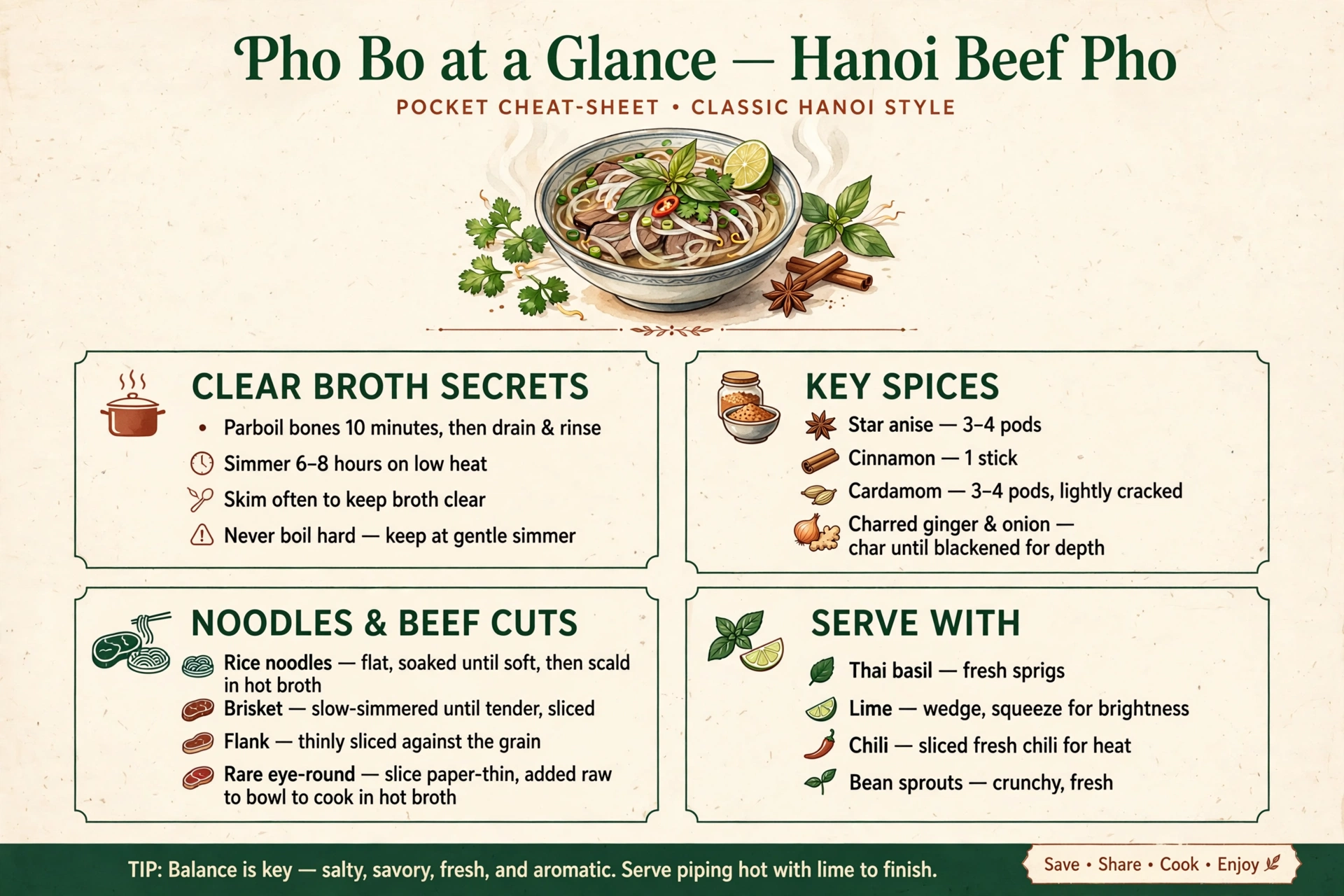
Direct answer: Five techniques keep Hanoi phở broth crystal-clear: parboil the bones for 10 minutes and discard the water; char ginger and onion until blackened; hold the pot at the barest simmer for 6–8 hours, skimming early foam; keep the lid slightly ajar; and add the spice bag only in the final 45–60 minutes, seasoning with fish sauce and rock sugar at the very end.
- Parboil — never skip it. Cover the bones with cold water, bring to a rolling boil for 10 minutes, then drain and rinse every bone under running water. This first boil pulls out blood and impurities that would otherwise cloud the broth permanently. Start the real simmer with clean bones and fresh water.
- Char until genuinely black. Put the whole ginger (skin on) and whole onions directly over a gas flame or in a dry cast-iron pan for 15–20 minutes, turning, until the skins blacken and blister. Lightly peel the ginger’s burnt skin afterward. Charring creates the smoky-sweet aroma that defines Hanoi phở — pale, steamed aromatics give you a flat, raw-tasting broth.
- A bare simmer, never a boil. Once the pot comes up to temperature, reduce the heat until only the occasional bubble breaks the surface. A hard boil churns fat and proteins back into the liquid and turns it milky. Skim the foam that rises during the first hour, then leave the pot alone.
- Lid ajar, not sealed. Rest the lid slightly off-center so steam escapes and the broth reduces gently. A tightly sealed lid traps condensation that drips back in and can dull the broth; the slow reduction also concentrates flavor over the long simmer.
- Spices late, seasoning last. Toast the spices on low heat for 3–5 minutes until fragrant (not smoking), tie them in a spice bag, and add them only for the final 45–60 minutes — simmered too long, they turn the broth bitter and medicinal. Fish sauce and rock sugar go in at the very end, tasted and adjusted, because long boiling flattens fish sauce’s aroma.
Step-by-step instructions
Direct answer: Parboil and rinse the bones (10 min), char the ginger and onion (15–20 min), toast the spices, then simmer everything at a bare simmer for 6–8 hours — lifting the brisket out after about 1.5–2 hours when tender. Strain, season, and assemble each bowl to order with blanched noodles, sliced brisket, raw rare beef, and herbs, ladling over broth just off the boil.
- Parboil the bones. Place marrow bones and oxtail in a large stockpot, cover with cold water, and boil hard for 10 minutes. Drain, rinse each piece under cold running water, and wash the pot clean.
- Char the aromatics. While the bones parboil, blacken the whole ginger and onions over an open flame or in a dry pan, 15–20 minutes, turning regularly.
- Toast the spices. In a dry skillet over low heat, toast the star anise, cinnamon, cardamom, cloves, coriander seeds, and fennel seeds for 3–5 minutes until fragrant. Tie them in a spice bag or cheesecloth.
- Start the simmer. Return the clean bones to the pot with about 4 liters of fresh cold water, the charred ginger and onion, and the brisket. Bring slowly to a bare simmer — never a rolling boil — and skim any foam during the first hour.
- Lift out the brisket. After about 1.5–2 hours, when the brisket is fork-tender, remove it, cool it, and refrigerate. (Cold brisket slices far more neatly later.) Keep the bones simmering.
- Simmer low and slow. Continue at the barest simmer with the lid ajar for 6–8 hours total from the start. Top up with hot water if the level drops below the bones.
- Add the spice bag. With 45–60 minutes left, drop in the spice bag. Remove it before it overstays — taste at 45 minutes.
- Strain and season. Lift out the bones and aromatics, strain the broth through a fine mesh (line it with cheesecloth for extra clarity), then season: start with 3 tablespoons of fish sauce and the rock sugar, then salt to taste. The broth should taste clean, savory, and aromatic — seasoned a touch stronger than you think, because the noodles will dilute it.
- Assemble to order. Blanch the noodles until just tender and divide among warmed bowls. Top with slices of brisket, shingles of paper-thin raw beef, scallions, thin white onion, and herbs. Ladle over broth just off a full boil — it should be steaming aggressively enough to cook the rare beef in seconds. Serve lime and chili on the side.
Common mistakes & how to fix them
Direct answer: Nearly every phở failure traces back to six fixable errors: boiling instead of simmering, skipping the parboil, adding spices too early, seasoning too soon, overcooking the brisket, or assembling the bowl in advance. The table below diagnoses each one.
| Problem | Likely cause | How to fix it |
|---|---|---|
| Cloudy, milky broth | Boiled too hard; skipped the parboil | Hold a bare simmer from the start. Next time, parboil the bones for 10 minutes and rinse before the real simmer. |
| Greasy mouthfeel | Too much rendered marrow fat | Chill the finished broth and lift off the solidified fat cap, or skim carefully with a ladle while warm. |
| Bitter, medicinal taste | Spices simmered too long or scorched while toasting | Keep the spice bag in for the final 45–60 minutes only; toast on low heat until just fragrant, never smoking. |
| Flat, bland broth | Under-seasoned; fish sauce added too early and cooked off | Season at the very end. Balance in this order: fish sauce for depth, rock sugar for roundness, salt for clarity. |
| Tough, dry brisket | Lifted too early or simmered too aggressively | Simmer gently until fork-tender (about 1.5–2 hours), rest it, and slice thinly against the grain. |
| Mushy noodles | Overcooked or left sitting in hot broth | Blanch noodles just until tender and always assemble each bowl to order — broth goes in last, at serving time. |
Seasoning, storing, reheating & serving
Direct answer: Season phở broth at the end in this order — fish sauce, then rock sugar, then salt — tasting until it reads clean and savory, never sweet. Cool leftovers within 2 hours; refrigerate 4–5 days or freeze up to 3 months (broth only, no noodles). Reheat gently to a simmer without hard-boiling, and serve with lime, sliced chili, and fresh herbs on the side.
Seasoning: Think of it as a triangle. Fish sauce brings savory depth, rock sugar rounds the edges, and salt sharpens everything into focus. Hanoi-style broth leans savory and aromatic — if it tastes sweet, you’ve gone southern. Season the broth slightly stronger than your target, because a full portion of noodles will dilute it in the bowl.
Storing: Cool the strained broth within 2 hours (an ice bath speeds this up), then refrigerate for 4–5 days or freeze for up to 3 months. Always store the broth alone — never with noodles or herbs, which turn soggy and dull. Freeze in portion-sized containers so you can thaw exactly what you need.
Reheating: Warm the broth gently back to a simmer; never let it boil hard, or you’ll undo hours of careful clarity work. If it reduced in storage, loosen it with a splash of hot water and re-check the seasoning — cold mutes salt perception, so taste again before serving.
Serving: A Hanoi bowl is assembled, not cooked together: blanched noodles first, then brisket and raw beef shingled on top, then scallions, paper-thin onion, and herbs — broth ladled over last, steaming. Put lime wedges and sliced bird’s eye chilies on the side and let each person finish their own bowl. If you want to round out the meal Hanoi-style, start with crispy nem ran (Vietnamese fried spring rolls) while the broth reheats.
Key takeaway: Leftover phở broth keeps 4–5 days refrigerated or 3 months frozen — always store it without noodles, reheat it gently to protect its clarity, and re-season lightly because cold dulls salt.
Learn phở hands-on in Hanoi
Direct answer: Reading a recipe gets you far, but phở is a technique dish — charring, skimming, and seasoning are learned by doing. Several Hanoi cooking classes teach phở on rotating menus, including Apron Up, Rose Kitchen, and Daisy Cooking Class. Compare all 12 Hanoi cooking classes side by side to find one with phở on the day’s menu, market tour included.
A good class walks you through the full method in 3–4 hours: charring the ginger and onion over real flame, building and seasoning the stock, slicing beef paper-thin, and assembling the bowl — then you eat your work. It’s also the fastest way to calibrate your palate: once you’ve tasted a correctly seasoned broth next to your own attempt, the seasoning triangle above will make instant sense. And if your trip covers more than one dish, our Hanoi bun cha guide pairs naturally with this recipe for a full northern menu.
Ready to cook phở with a Hanoi chef? Tell us your travel dates on WhatsApp or email us and we’ll match you with a class that teaches phở — market tour, hands-on broth, recipe to take home.
Conclusion
Great Hanoi phở at home isn’t about secret ingredients — it’s about discipline: clean bones, blackened aromatics, a patient bare simmer, late spices, and last-minute seasoning. Follow the method above and your kitchen will smell like a Hanoi sidewalk at 7 a.m. And when the broth finally turns that crystal-clear amber, you’ll understand why the city’s cooks guard these small techniques so carefully.
If this recipe gave you the cooking bug, the next step is doing it beside someone who has made it ten thousand times. Browse the Hanoi cooking classes, pick one with phở on the menu, and come taste the difference a real flame makes.
Key takeaway: You don’t need rare ingredients to make authentic Hanoi phở at home — you need the right technique: parboiled bones, charred aromatics, a 6–8 hour bare simmer, and seasoning added last. Master that, and the bowl takes care of itself.
Frequently asked questions
How long does it really take to make phở bò from scratch?
About 8–9 hours total, but only around 45 minutes is active work — parboiling, charring, toasting spices, skimming, and assembly. The 6–8 hour simmer is unattended; start it in the morning and assemble bowls for dinner.
Why is my phở broth cloudy?
Almost always one of two causes: you skipped the 10-minute parboil (blood and impurities stayed in), or the pot boiled too hard instead of holding a bare simmer. Keep the heat low enough that only an occasional bubble breaks the surface, and skim foam during the first hour. See the troubleshooting table above for the full diagnosis.
Can I make phở bò in a pressure cooker?
Yes — it’s the best weeknight shortcut. Parboil and char exactly as described, then pressure-cook the bones for 60–90 minutes instead of the long simmer. The broth won’t reach the depth or clarity of the 6–8 hour version, but with late spices and careful end-seasoning it gets impressively close.
What’s the difference between Hanoi phở and southern phở?
Hanoi phở is the original: a clean, delicate broth, restrained seasoning, and minimal garnishes. Southern-style bowls tend sweeter, with a generous plate of bean sprouts, Thai basil, and hoisin sauce on the side. For the full comparison plus prices and where locals eat, see our complete Hanoi phở guide.
Can I use chicken instead of beef?
That becomes phở gà — a beloved Hanoi breakfast in its own right, with a lighter broth simmered about 2–3 hours. The charred ginger-and-onion technique is the same, but the spice balance and timing differ enough that it deserves its own recipe.
How should I store and reheat leftover phở?
Cool the strained broth within 2 hours, refrigerate 4–5 days or freeze up to 3 months — always without noodles or herbs. Reheat gently to a simmer (never a hard boil), loosen with hot water if it reduced, and re-check seasoning before assembling fresh bowls.