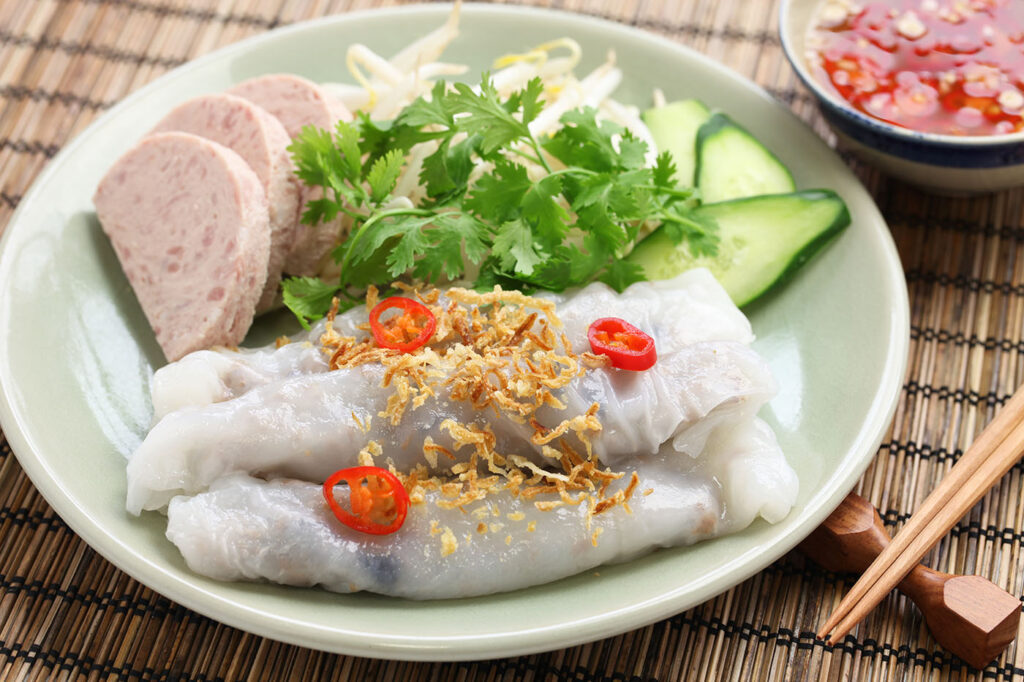
Direct answer: This banh cuon recipe makes Hanoi’s famous steamed rice rolls at home: a thin batter of rice flour, tapioca starch, and water, steamed into translucent sheets and rolled around savory pork and wood-ear mushroom filling. You get two steaming methods — the traditional cloth steamer for the most authentic texture, and a nonstick skillet that works in any kitchen. Total hands-on time is about 1 hour for 4 servings.
Banh Cuon — Hanoi Steamed Rice Rolls at a Glance
- Prep time: 30 minutes (batter rest included)
- Cook time: 30 minutes
- Total time: about 1 hour
- Servings: 4 (about 20–24 rolls)
- Difficulty: Medium — the technique takes 2–3 practice rolls
- Calories: roughly 350–400 kcal per serving (estimate from the ingredients)
Banh cuon is the quiet genius of Hanoi breakfast. While pho gets the fame, these paper-thin steamed rice sheets — silkier than any noodle, lighter than any pancake — have been Hanoi’s morning ritual for centuries. The dish was born in Thanh Tri, an ancient suburb on the banks of the Red River, where village cooks learned to steam rice batter into sheets so thin they turn almost transparent. Follow this banh cuon recipe step by step and you’ll learn both ways to make them: the traditional cloth-steamer technique the Thanh Tri artisans still use, and the nonstick-pan shortcut that brings the dish within reach of any home kitchen.
Learn it hands-on in Hanoi: banh cuon is one of the most-requested dishes in Hanoi cooking classes — lifting your first rice sheet off the steamer is a skill best learned standing next to a teacher. Message us on WhatsApp or email us and we’ll match you with a class that teaches it the real Hanoi way.
In this guide
- What Is Banh Cuon, and Where Does It Come From?
- What Ingredients Do You Need for This Banh Cuon Recipe?
- Way 1: How Do You Steam Banh Cuon the Traditional Cloth-Steamer Way?
- Way 2: How Do You Make Banh Cuon in a Nonstick Pan?
- How Do You Make the Pork and Mushroom Filling?
- How Do You Serve Banh Cuon the Hanoi Way?
- Common Banh Cuon Mistakes (and How to Fix Them)
- Where Can You Learn Banh Cuon in a Hanoi Cooking Class?
- Frequently Asked Questions
What Is Banh Cuon, and Where Does It Come From?
Direct answer: Banh cuon are Vietnamese steamed rice rolls made from a thin rice-flour batter steamed into delicate, translucent sheets, then rolled around a savory filling of minced pork and wood-ear mushrooms. The dish originated in Thanh Tri, an ancient suburb of Hanoi on the Red River, and is traditionally eaten for breakfast with fried shallots, cha lua (Vietnamese pork sausage), and nuoc cham dipping sauce.
The original banh cuon Thanh Tri is even simpler than the version most visitors meet: plain, unfilled rice sheets, paper-thin and almost transparent, served at room temperature with nothing but fried shallots and a bowl of dipping sauce. It began as a humble village food — Thanh Tri’s soil was not rich enough for abundant rice harvests, so turning a small amount of rice into a full breakfast plate was an act of ingenuity. Over generations, the filled version with pork and mushrooms became Hanoi’s standard, and today a plate of banh cuon from a good street vendor costs roughly 30,000–50,000 VND (about $1.20–$2.00, based on a 2026 roundup of Hanoi breakfast dishes).
The dish has inspired some of Vietnam’s finest food writing. Vu Bang, a writer celebrated for his prose on old Hanoi, described how visitors who tasted banh cuon served with hot fried tofu in the capital never forgot it — and how, away from home during wartime, he longed for everything about it, from the dipping sauce and the texture to the graceful posture of the pancake vendor (as reported by Viet Nam News). That is the standard this banh cuon recipe aims at: sheets thin enough to read through, filling fragrant enough to remember.
What Ingredients Do You Need for This Banh Cuon Recipe?
Direct answer: The batter needs only rice flour, tapioca starch, water, salt, and a little oil; the filling is ground pork, rehydrated wood-ear mushrooms, shallots, fish sauce, sugar, and black pepper. Serve with nuoc cham, crispy fried shallots, cha lua slices, cucumber, bean sprouts, and fresh herbs.
The tapioca starch is not optional — it is what gives the sheets their signature stretch and slight chew. Rice flour alone makes sheets that tear; the 3:1 ratio of rice flour to tapioca starch (300g to 100g per liter of water) is the proportion most Hanoi home cooks use in a classic banh cuon recipe. Resting the batter for at least 30 minutes matters too: it lets the flour fully hydrate, which is the difference between a silky sheet and a grainy one.
| Component | Ingredient | Amount |
|---|---|---|
| Batter | Rice flour | 300 g |
| Tapioca starch | 100 g | |
| Room-temperature water | 1 liter | |
| Salt | ½ teaspoon | |
| Vegetable oil | 1 tablespoon, plus more for brushing | |
| Filling | Ground pork | 200 g |
| Dried wood-ear mushrooms, soaked and finely chopped | 100 g | |
| Shallots or 1 small onion, minced | 2–3 | |
| Garlic, minced | 2 cloves | |
| Fish sauce | 2 tablespoons | |
| Sugar + freshly ground black pepper | 1 teaspoon + to taste | |
| To serve | Nuoc cham (sweet-sour fish sauce dip) | 1 cup |
| Crispy fried shallots | 3–4 tablespoons | |
| Cha lua (Vietnamese pork sausage), sliced | 200 g, optional but recommended | |
| Cucumber, bean sprouts | 1 cup each | |
| Fresh mint and cilantro | a handful |
Equipment: For Way 1, a wide pot, a piece of tightly woven cotton cloth (a clean pillowcase works) large enough to stretch over the pot, string or a large rubber band, a lid, and a thin flat bamboo stick or flexible spatula. For Way 2, a 9-inch (23 cm) nonstick skillet with a lid.
Way 1: How Do You Steam Banh Cuon the Traditional Cloth-Steamer Way?
Direct answer: Stretch a damp cotton cloth taut over a pot of boiling water, ladle a thin layer of rested batter onto the cloth, cover, and steam for 40–60 seconds until the sheet turns translucent. Lift it off with a thin bamboo stick onto an oiled tray. This is how Thanh Tri artisans have made banh cuon for generations, and it produces the thinnest, silkiest sheets.
- Mix and rest the batter. Whisk the rice flour, tapioca starch, water, salt, and 1 tablespoon of oil in a large bowl until completely smooth. Let it rest for 30 minutes. If a thin layer of clear water rises to the top, pour it off and replace it with the same amount of fresh water — an old Hanoi trick that keeps the sheets from tasting starchy.
- Set up the steamer. Fill a wide pot two-thirds full with water and bring it to a rolling boil. Stretch the damp cloth tightly over the pot mouth — it must be drum-taut, with no sagging in the middle, or the batter will pool — and secure it with string. Lightly brush the cloth with oil.
- Steam the first sheet. Stir the batter (it settles fast), then ladle about ¼ cup onto the cloth and spread it quickly in a thin, even circle with the back of the ladle. Cover with the lid and steam for 40–60 seconds. The sheet is done when it turns translucent and small bubbles appear on the surface — no opaque white patches.
- Lift and transfer. Uncover and slide the bamboo stick under one edge of the sheet, lifting left to right in one smooth motion. Lay the sheet on a tray brushed with oil so it doesn’t stick.
- Fill and roll. Spoon a line of the pork filling (see below) along one edge and roll the sheet into a loose cylinder. Don’t roll tight — banh cuon should be pillowy, not dense.
- Repeat. Stir the batter before every ladle. Adjust as you go: if sheets tear, the batter is too thick (add 1–2 tablespoons of water); if they won’t set, it’s too thin (add 1 tablespoon of rice flour).
The first 2–3 sheets are practice — every Hanoi vendor will tell you the same. By sheet five, your hands will know the rhythm of this banh cuon recipe: ladle, spread, cover, count to fifty, lift, roll.
Way 2: How Do You Make Banh Cuon in a Nonstick Pan?
Direct answer: Heat a 9-inch nonstick skillet over medium-low heat, brush lightly with oil, ladle in a thin swirl of batter, cover, and cook 1–2 minutes until the sheet turns translucent and set. Flip the pan over onto an oiled tray to release the sheet, then fill and roll. No steamer, no cloth, no special equipment — and the result is about 90% as good as the traditional way.
- Prepare the pan. Brush a 9-inch nonstick skillet with a thin film of oil and heat it over medium-low heat. Too hot and the batter sets before you can swirl it; too cool and it sticks.
- Swirl the batter. Stir the batter, ladle in about ¼ cup, and immediately tilt and swirl the pan so the batter coats the bottom in a thin, even layer.
- Cover and steam. Put the lid on and cook for 1–2 minutes, until the sheet turns fully translucent and the edges start to pull away from the pan.
- Release and roll. Brush a large plate or tray with oil, place it over the pan, and flip the pan over in one motion — the sheet drops onto the tray. Spoon filling along one edge and roll gently.
- Repeat. Re-oil the pan lightly between sheets only if they start sticking; with a good nonstick pan you can often go several sheets without more oil.
Which way should you choose? If this is your first time making this banh cuon recipe, start with the pan — it is forgiving, and the sheets are only slightly thicker. Once you can swirl a perfect thin layer in your sleep, graduate to the cloth steamer for the true Thanh Tri texture: sheets so thin they are nearly transparent.
How Do You Make the Pork and Mushroom Filling?
Direct answer: Soak the wood-ear mushrooms in hot water until soft, then chop finely. Sauté minced shallots and garlic in a splash of oil, add the ground pork and break it up, cook until no longer pink, then stir in the mushrooms, fish sauce, sugar, and black pepper. Cook until the mixture is fragrant and all liquid has evaporated — about 8 minutes total.
- Soak the dried wood-ear mushrooms in hot water for 15–20 minutes until fully rehydrated. Drain, squeeze dry, and mince finely.
- Heat a splash of oil in a skillet over medium heat. Sauté the minced shallots and garlic until fragrant, about 1 minute.
- Add the ground pork, breaking it up with a spatula. Cook until it is no longer pink, about 5 minutes.
- Stir in the chopped mushrooms, fish sauce, sugar, and a generous grind of black pepper. Cook 2–3 minutes more, until the mixture is fragrant and any liquid has evaporated. A wet filling makes soggy rolls — this step matters.
- Remove from heat and set aside. The filling should be savory, peppery, and just moist, never soupy.
Vegetarian option: replace the pork with finely chopped king oyster mushrooms or extra wood-ears plus crumbled tofu, seasoned the same way. The technique doesn’t change.
How Do You Serve Banh Cuon the Hanoi Way?
Direct answer: Arrange the warm rolls on a plate, shower them with crispy fried shallots, and serve with nuoc cham (a sweet-sour fish sauce dip), slices of cha lua, cucumber, bean sprouts, and fresh mint and cilantro on the side. Dip each bite — never pour the sauce over the plate.
The nuoc cham for banh cuon is lighter than the one used for bun cha: roughly 3 parts water to 1 part fish sauce, with sugar, lime juice, minced garlic, and chili to taste. It should taste bright and gently sweet, never aggressively salty — the delicate rice sheets can’t stand up to a heavy sauce.
For the full Hanoi experience, add sliced cha lua (steamed pork sausage) alongside the rolls, exactly as the vendors in the Old Quarter do. If you want to taste the Thanh Tri original, make a few rolls from this banh cuon recipe without filling, roll them plain, and serve them at room temperature with extra fried shallots — that minimalist version is what made the village famous in the first place.
Common Banh Cuon Mistakes (and How to Fix Them)
Direct answer: The three most common banh cuon recipe failures are sheets that tear (batter too thick or cloth not taut), sheets that stick (not enough oil on the tray or cloth), and soggy rolls (wet filling). All three are fixed in seconds once you know what to look for.
| Mistake | Why it happens | Fix |
|---|---|---|
| Sheets tear when lifted | Batter too thick, or under-steamed | Thin the batter with 1–2 tbsp water per cup; steam until fully translucent with no white patches |
| Batter pools in the middle | Cloth sagging under the ladle’s weight | Re-stretch the cloth drum-taut; spread the batter in one quick motion |
| Sheets stick to the cloth or pan | Surface too dry, or heat too low | Brush the cloth/tray with oil; make sure water is at a full boil (cloth method) |
| Rolls turn soggy | Filling released liquid after rolling | Cook the filling until completely dry; let it cool slightly before filling |
| Sheets taste floury or raw | Batter not rested, or flour not fully hydrated | Rest the batter a full 30 minutes; pour off the clear water that rises and replace it |
| Rolls are gummy and dense | Rolled too tight, or batter too thick | Roll loosely — two gentle turns, not a tight wrap; thin the batter slightly |
Where Can You Learn Banh Cuon in a Hanoi Cooking Class?
Direct answer: Many Hanoi cooking classes include banh cuon in their hands-on menus, and it is one of the best dishes to learn in person — the sheet-lifting technique is hard to grasp from text alone. Read our guide on what to expect at a Hanoi cooking class before you book, and check current Hanoi cooking class prices by month to pick the best-value season.
Well-reviewed options in the Old Quarter include Rose Kitchen and Apron Up, both known for small hands-on sessions that start with a market visit. For that market visit, our Dong Xuan Market morning guide shows where Hanoi’s chefs buy their rice flour and fried shallots — the same ingredients in this banh cuon recipe. And if banh cuon has you hooked on Hanoi street food, our crispy nem ran recipe is the natural next project.
Key takeaway: This banh cuon recipe is 90% technique and 10% ingredients — rest the batter 30 minutes, keep the cloth drum-taut (or the pan at medium-low), steam until fully translucent, and roll loosely. Master those four things and your home banh cuon will rival Hanoi’s street vendors.
Ready to Steam Your First Batch?
Banh cuon rewards patience more than precision. Your first sheets will be imperfect — too thick, slightly torn, rolled a little lopsided — and they will still taste better than almost anything else you can make in an hour. That is the quiet magic of this banh cuon recipe: rice, water, and a minute of steam, transformed into something worth writing poetry about. Start with the pan method tonight, and when you’re ready for the real thing, stretch a cloth over a pot and steam like Thanh Tri.
Want a teacher for your first try? Join a Hanoi cooking class and learn banh cuon alongside pho, bun cha, and nem ran in one morning. Message us on WhatsApp or email us — tell us you read the banh cuon recipe article and we’ll recommend the right class for you.
Frequently Asked Questions
What is the difference between banh cuon and banh uot?
They are close cousins. Banh cuon (northern style) is usually rolled around a pork and wood-ear mushroom filling and served warm with nuoc cham. Banh uot (central/southern style) is typically served as unfilled sheets with toppings. The batter and steaming technique are nearly identical — this banh cuon recipe works for both.
Can I make banh cuon without a steamer cloth?
Yes — Way 2 in this banh cuon recipe uses a nonstick skillet with a lid, and no special equipment at all. The sheets come out slightly thicker than cloth-steamed ones, but the flavor is the same and the technique is much easier for beginners.
Why is my banh cuon batter lumpy?
The flour wasn’t fully hydrated. Whisk the batter until completely smooth, then rest it for at least 30 minutes — and always stir it right before ladling, because the starch settles to the bottom within seconds.
Is banh cuon gluten-free?
Yes, the traditional batter is naturally gluten-free: just rice flour, tapioca starch, water, salt, and oil. Check that your fish sauce and any store-bought fried shallots are also gluten-free if you are highly sensitive.
Can I prepare banh cuon ahead of time?
Banh cuon is best eaten within an hour of steaming — the sheets firm up as they cool. You can make the filling and nuoc cham a day ahead, but steam the sheets fresh. Leftover rolls can be briefly re-steamed for 30 seconds to soften them again.
What does “banh cuon Thanh Tri” mean?
It refers to the original style from Thanh Tri village near Hanoi: plain, unfilled rice sheets, paper-thin and nearly transparent, traditionally served at room temperature with fried shallots and dipping sauce. Many Hanoians still consider it the purest form of the dish.
Sources: batter ratios and steaming technique cross-checked against published recipes from Saigon Supper, Chopped, and FoodVietnamese (accessed October 2026); history of Thanh Tri origin and Vu Bang’s writing via Viet Nam News; street price range from a 2026 Hanoi breakfast roundup. Prices noted are research snapshots as of October 2026.