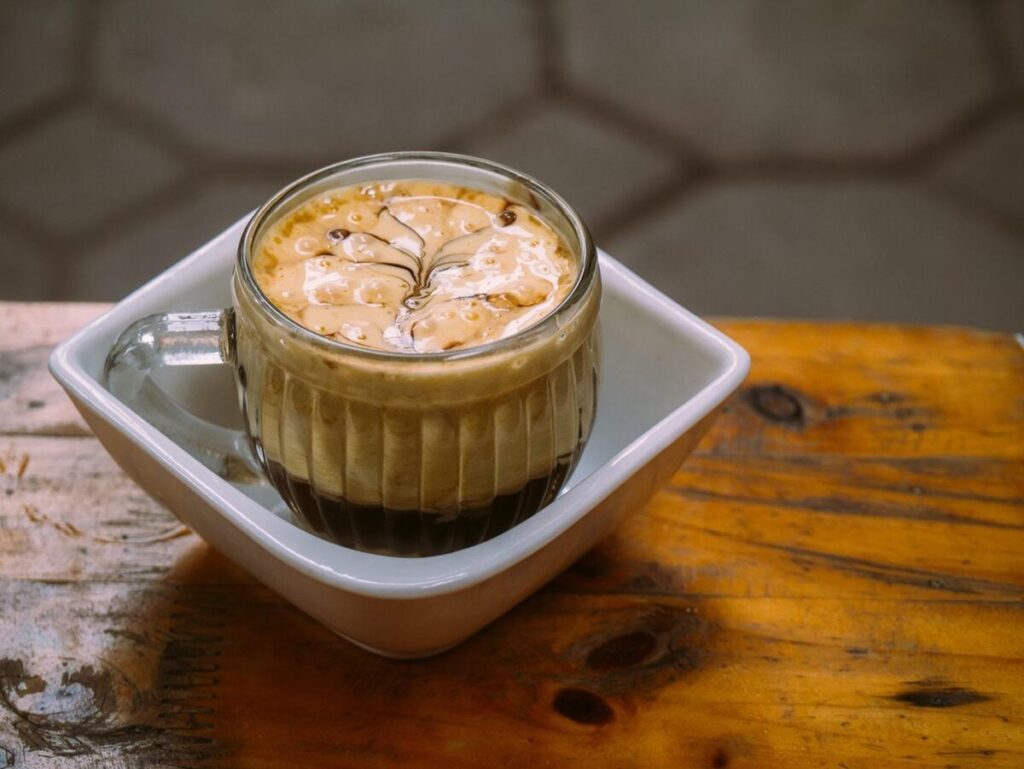
Direct answer: To make authentic Vietnamese egg coffee (cà phê trứng), whip 2 fresh egg yolks with 2 tablespoons of sweetened condensed milk for 3–5 minutes until thick and pale, then spoon the silky foam over 60 ml of strong, hot phin-brewed coffee. This egg coffee recipe takes about 10 minutes and needs nothing more than a hand mixer and a small glass.
Cà Phê Trứng — Vietnamese Egg Coffee Recipe at a Glance
- Prep time: 5 minutes
- Whipping time: 5 minutes
- Total time: 10 minutes
- Servings: 1 cup
- Difficulty: Easy
- Calories: roughly 230–250 kcal per serving (estimate from the ingredients)
Hanoi’s egg coffee looks like dessert, drinks like coffee, and has fooled first-time visitors into asking whether it contains ice cream. It contains no ice cream — just egg yolks, condensed milk, and very strong coffee, whipped into something between a custard and a cloud. This egg coffee recipe gives you the exact ratios, the whipping technique that kills the eggy smell, and the fixes for every common failure.
Learn it hands-on in Hanoi: egg coffee is a staple demo in most Hanoi cooking classes. Message us on WhatsApp or email us and we’ll match you with a class that teaches this drink the real Hanoi way.
In this guide
- What Makes Egg Coffee Different from Regular Coffee?
- Egg Coffee Recipe: Ingredients and Equipment
- How to Make Egg Coffee: Step-by-Step
- How Do You Drink Egg Coffee the Hanoi Way?
- Common Egg Coffee Mistakes (and How to Fix Them)
- Is Egg Coffee Safe to Drink?
- Where Can You Learn Egg Coffee in a Hanoi Cooking Class?
- Frequently Asked Questions
What Makes Egg Coffee Different from Regular Coffee?
Direct answer: Egg coffee replaces milk foam with a sweet whipped cream of egg yolks and condensed milk, layered over intensely bitter Vietnamese Robusta. The result tastes like liquid tiramisu: bitter coffee at the bottom, rich custard-like foam on top, with no raw-egg flavor when whipped properly. Unlike most versions online, this egg coffee recipe keeps the coffee concentrated enough to hold its own under the sweet foam.
The drink was born from scarcity. In 1940s Hanoi, fresh milk was scarce and expensive, so cafés experimented with egg yolks as a creamy substitute for milk in coffee. What began as a wartime improvisation became a signature Hanoi drink — one that international food guides now rank among the city’s must-try experiences, and one we covered in depth in our article on the 1946 story of how egg coffee was invented.
The coffee underneath matters as much as the foam. Traditional cà phê trứng uses Vietnamese Robusta — dark, punchy, and bitter enough to cut through the sweet foam. A mild Arabica latte base gets completely buried; the drink needs coffee with backbone.
Egg Coffee Recipe: Ingredients and Equipment
Direct answer: For one serving of this egg coffee recipe you need 2 egg yolks, 2 tablespoons of sweetened condensed milk, 60 ml of strong coffee, plus a pinch of salt and a few drops of vanilla extract. The essential equipment is a hand mixer, a phin filter (or any way to make strong coffee), and a small heatproof glass.
| Ingredient / Tool | Amount | Notes |
|---|---|---|
| Fresh egg yolks | 2 | Room temperature; separate carefully — whites ruin the foam |
| Sweetened condensed milk | 2 tablespoons | The classic sweetener; honey works but changes the flavor |
| Pinch of fine salt | A tiny pinch | Sharpens the flavor, cuts any eggy aftertaste |
| Vanilla extract | 3–4 drops | Masks the raw-egg aroma; a drop of rum is the traditional alternative |
| Strong Vietnamese coffee | 60 ml (¼ cup) | Phin-brewed Robusta, or a double shot of espresso |
| Cocoa powder | Optional dusting | For looks and a hint of bitterness on top |
| Hand mixer with whisk | — | Essential: hand-whisking yolks takes far too long |
| Phin filter or espresso maker | — | Strong instant coffee (1 tsp in 60 ml hot water) works in a pinch |
| Small heatproof glass + bowl of hot water | — | The warm-water bath keeps the drink hot while you sip |
The ratio in this egg coffee recipe is forgiving: use 1–2 yolks, 1–2 tablespoons of condensed milk, and one shot of strong coffee, adjusting to taste. More condensed milk makes a sweeter, thicker foam; less makes the coffee’s bitterness shine through. Hanoian cafés lean sweet — the original 1946 version was unapologetically rich.
How to Make Egg Coffee: Step-by-Step
Direct answer: Brew strong coffee first, then whip the yolks, condensed milk, salt, and vanilla over a warm-water bath for 3–5 minutes until pale and tripled in volume, then spoon the foam over the hot coffee and serve immediately in a bowl of warm water.
- Brew the coffee strong and hot. Everything in this egg coffee recipe depends on a concentrated base, so resist the urge to make a full mug. Brew 60 ml of Vietnamese coffee with a phin filter, or pull a double espresso shot. Pour it into a small heatproof glass. Set the glass inside a larger bowl filled with hot water — this keeps the drink warm while you work, exactly as Hanoi cafés serve it.
- Combine the egg mixture. Put the 2 egg yolks, condensed milk, salt, and vanilla extract into a small bowl. Stir briefly with a spoon just to combine — no need to be precise yet.
- Warm the bowl. Rest the bowl in hot water (around 60°C / 140°F). Gentle warmth helps neutralize the raw-egg aroma and builds a more stable foam. Do not use boiling water — you are not cooking the eggs.
- Whip for 3–5 minutes. Beat with a hand mixer on medium-high until the mixture is pale, thick, and roughly tripled in volume. The classic readiness test: drop a spoonful into cold water — if it floats and holds its shape, the foam is ready.
- Layer, don’t pour. Spoon the egg cream gently over the hot coffee rather than pouring it in a stream. Spooning preserves the distinct layers: dark coffee below, golden foam above.
- Dust and serve immediately. A light dusting of cocoa powder is optional. Drink within 5–10 minutes, while the foam is airy and the coffee is hot. Sip through the foam first, then stir if you prefer it blended.
How Do You Drink Egg Coffee the Hanoi Way?
Direct answer: In Hanoi, egg coffee is sipped slowly through the foam with a spoon, served hot in a bowl of warm water. The original is at Café Giang (39 Nguyễn Hữu Huân, Old Quarter), where a hot egg coffee costs around 35,000 VND — price snapshot from research on October 12, 2026; menu prices change, so confirm on arrival.
Café Giang is where Nguyen Van Giang, a former bartender at the Sofitel Legend Metropole, opened his own shop in 1946 and turned his milk-scarcity improvisation into a Hanoi institution. His family still runs it today. A second family branch, Café Dinh at 13 Đinh Tiên Hoàng, was opened in 1987 by his daughter and serves the same recipe opposite Hoan Kiem Lake. For the practical details on both cafés, see this guide to Hanoi’s original egg coffee cafés.
The Hanoi drinking ritual is part of the experience: no stirring at first. Once you have this egg coffee recipe down at home, try drinking it exactly this way — it changes the drink. Scoop a little foam with the spoon, taste the sweet custard, then let the bitter coffee rise through it. Hanoians linger over one cup for half an hour — egg coffee is not a grab-and-go drink.
If you want the full background before you brew, read the 1946 story of Hanoi’s egg coffee — it covers how this drink survived 80 years and became a global Hanoi icon.
Common Egg Coffee Mistakes (and How to Fix Them)
Direct answer: The three most common failures cooks report with this egg coffee recipe are an eggy smell (under-whipped or no vanilla), a flat foam (yolks too cold or whites mixed in), and watery coffee drowning the foam. All three are fixable without starting over — except a collapsed foam, which needs re-whipping.
| Mistake | Why it happens | The fix |
|---|---|---|
| It smells/tastes like raw egg | Under-whipped; missing vanilla or rum; bowl not warmed | Whip longer until pale and tripled; add vanilla; warm the bowl in hot water next time |
| Foam is thin and won’t thicken | Egg whites got in; yolks too cold; weak mixer | Separate yolks more carefully; use room-temperature eggs; whip at medium-high for the full 3–5 minutes |
| Coffee is watery under the foam | Weak brew or too much water | Use a phin or double espresso — the coffee must be concentrated; 60 ml is plenty |
| Foam sinks into the coffee | Poured instead of spooned; foam under-whipped | Spoon the foam on gently over the back of a spoon; re-whip if it looks loose |
| Drink goes cold before finishing | No warm-water bath | Serve the glass sitting in a bowl of hot water, as Hanoi cafés do |
Is Egg Coffee Safe to Drink?
Direct answer: Egg coffee uses lightly warmed, not cooked, egg yolks — so use very fresh, clean eggs, and pasteurized eggs if you are pregnant, elderly, or immunocompromised. The warm-water bath (around 60°C) reduces the raw-egg aroma but does not fully cook the yolks, so freshness is the real safety measure.
At home, buy the freshest eggs you can, check for cracked shells, and whip the foam right before serving — never make it in advance. Follow that rule and this egg coffee recipe is as safe as any café version. If anyone at the table is in a higher-risk group, pasteurized egg yolks whip into an identical foam. Hanoi cafés have served this drink daily for 80 years using the same basic method; the risk comes from poor egg quality, not from the recipe itself.
Where Can You Learn Egg Coffee in a Hanoi Cooking Class?
Direct answer: Most Hanoi cooking classes include egg coffee as a demo or hands-on segment, typically alongside dishes like pho, bun cha, and nem ran. Classes in the Old Quarter often end the session with it, served the traditional way in a warm-water bath.
Making egg coffee with a Hanoian chef teaches you what even the best egg coffee recipe cannot: the exact whipping sound when the foam is ready, how the spoon should stand in it, and how bitter your Robusta base should taste before the foam goes on. If you are choosing a class, our guide to cooking classes in Hanoi’s Old Quarter compares the best options by location, and our direct vs OTA booking guide shows how to book the same class for less.
Typical class menus pair egg coffee with authentic Hanoi pho, bun cha, and spring rolls — so one morning teaches you both the savory classics and this famous dessert drink.
Key takeaway: Authentic egg coffee is 2 whipped yolks + 2 tablespoons condensed milk over 60 ml of strong hot coffee — 10 minutes, one hand mixer, no special skill. Whip until the foam floats on water, spoon it over the coffee, and serve in a warm-water bath.
Coming to Hanoi? Skip the trial and error — learn egg coffee from a local chef in a morning class, then drink the original at Café Giang the same afternoon. Chat with us on WhatsApp or email us and tell us your dates.
The Final Word: Should You Make Egg Coffee at Home?
Yes — egg coffee is one of the easiest Vietnamese recipes to nail at home, and this egg coffee recipe removes the guesswork. The ingredient list is tiny, the technique is a single whipping step, and the payoff is a drink that genuinely tastes like the one at Café Giang. Your first cup may be slightly less dense than the Hanoi original; by the third, you will have the ratio dialed to your taste. And if you ever find yourself in Hanoi, do the pilgrimage anyway: some things are worth tasting at the source.
Frequently Asked Questions
Can I make egg coffee without a phin filter?
Yes. A phin gives the most authentic bitter base, but a double shot of espresso or 1 teaspoon of strong instant coffee dissolved in 60 ml of hot water works well — this egg coffee recipe is built around concentration, not any specific brewer. What matters is concentration, not the brewing device — weak coffee disappears under the sweet foam. Avoid drip or French-press coffee unless you brew it extra strong.
Is the raw egg in egg coffee safe?
The yolks are gently warmed (around 60°C), not cooked, so use very fresh eggs with intact shells and whip the foam just before serving. Pregnant women, young children, the elderly, and immunocompromised people should use pasteurized egg yolks, which whip into an identical foam. Never store leftover egg foam.
Which coffee works best for egg coffee?
Dark-roasted Vietnamese Robusta is the traditional and best choice — its bitterness balances the sweet foam. A double shot of espresso is a good substitute. Mild or lightly roasted Arabica gets overpowered by the foam, and the drink ends up tasting like sweet custard with coffee-colored water underneath.
Why does my egg coffee taste eggy?
Almost always because the foam was under-whipped. Whip the yolks, condensed milk, salt, and vanilla for the full 3–5 minutes until pale, thick, and tripled in volume — and warm the bowl in hot water while whipping. A properly whipped foam tastes like sweet custard, with no raw-egg flavor at all.
Can I make egg coffee in advance?
No — the whipped egg foam must be made and served fresh. It starts to deflate and separate within 15–20 minutes, and food-safety rules say raw-egg foam should not sit around. The good news: the whole recipe takes 10 minutes, so there is no reason to prep ahead.
Can I make a less sweet version of egg coffee?
Yes. Reduce the condensed milk to 1 tablespoon and skip the optional sugar — the foam will be slightly thinner but the coffee’s bitterness will come forward, which many Hanoians actually prefer. Do not replace condensed milk with regular milk entirely; the foam needs the condensed milk’s thickness and sugar to whip properly.
Sources
- Savour the Pho — Authentic Egg Coffee (Vietnamese Cà Phê Trứng) (recipe method and whipping test)
- Imbibe Magazine — Vietnamese Egg Coffee recipe from Nini Nguyen’s Đặc Biệt (ingredient ratios)
- AsiaTourAdvisor — Hanoi Egg Coffee guide 2026 (Café Giang address, hours, prices)